INSAP TraceChain
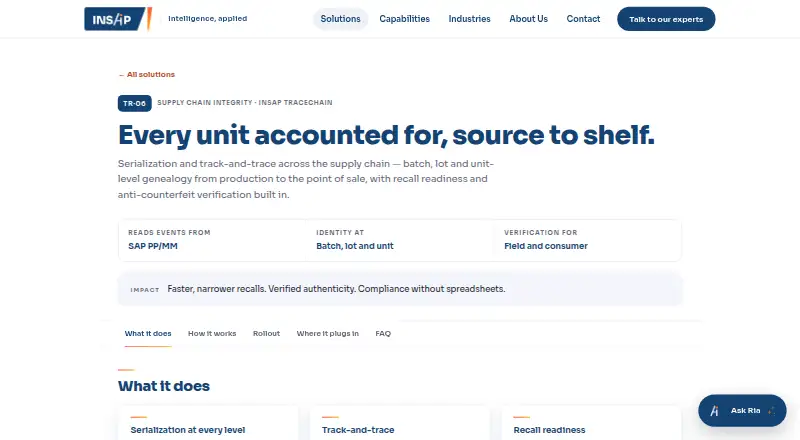
INSAP TraceChain manages product serialization and supply-chain traceability from production to point of sale.
What INSAP TraceChain is
INSAP TraceChain manages product serialization and supply-chain traceability from production to point of sale. It assigns batch-, lot-, or unit-level identities and links production and movement events into product genealogy across plants, depots, channel partners, and shelves. The system can use events from SAP PP/MM and depot systems, with recall actions returning to the ERP as governed transactions. INSAP says teams can use genealogy and expiry visibility to identify affected units and destinations within minutes. Field teams and consumers can scan against the genuine record; duplicate or out-of-territory scans are flagged. Coding supports GS1 and customer-specific formats. Traceability reaches only the last point where a scan is recorded. Events are append-only, with corrections stored as new attributed events. Public scans reveal only customer-selected information, typically authenticity, batch, and expiry. Pricing is on request and licensing depends on serialized volume and the lines and nodes included, scoped after serialization design.
Good
- Tracks batch-, lot-, and unit-level identities.
- Flags duplicate and out-of-territory scans.
- Supports GS1 and customer-specific coding.
- Recall actions can return to ERP as governed transactions.
Watch out
- Traceability ends at the last point that scans.
- Some serialization levels may require new hardware.
- Pricing is available on request.
Who it suits
TraceChain is aimed at organizations needing serialization, product genealogy, and recall management, particularly in pharmaceuticals and life sciences. It may suit teams connecting production, depot, and channel events while keeping public scan information limited.
Verdict
TraceChain combines serialization, genealogy, verification scans, and recall workflows across supply-chain events. Buyers should account for scan coverage limits and scope-based licensing when planning an implementation.
Plans and prices
From INSAP TraceChain's own pricing page, checked 8 Oct 2026.
| Plan | Price | What it gives you |
|---|---|---|
| INSAP TraceChain | Priced on request | Licensed by serialized volume and the number of lines and nodes in scope; scoped after serialization design |
The facts
Each one read from INSAP TraceChain's own pages, with the date it was checked.
What it does
- Authenticity checks
- Field teams and consumers can scan to verify against the genuine record, and duplicate or out-of-territory scans are flagged.checked 8 Oct 2026
- Coding formats
- The coding scheme accommodates GS1 and customer-specific formats.checked 7 Oct 2026
- Coding standards
- The coding scheme accommodates GS1 and customer-specific formats.checked 8 Oct 2026
- Coverage limit
- Traceability extends to the last point that scans; consumer verification covers the final step for chains with non-scanning retailers or trade.checked 8 Oct 2026
- Data location
- Traceability data is stored in a chosen region; the stated default for Indian customers is Central India, with in-country deployment where a market requires it.checked 8 Oct 2026
- Genealogy
- It tracks product genealogy across plants, depots, channel partners, and the shelf.checked 7 Oct 2026
- Integrations
- Reads production and movement events from SAP PP/MM and depot systems, exposes verification to field apps and consumer scans, and sends recall actions back to the ERP.checked 8 Oct 2026
- Intended industries
- The maker identifies pharmaceuticals and life sciences as an industry use case, citing batch genealogy, expiry pressure and compliance trails.checked 8 Oct 2026
- Licensing
- Licensing is based on serialized volume and the number of lines and nodes in scope, with scope determined after serialization design.checked 7 Oct 2026
- Line requirements
- The maker says implementation usually uses printing and scanning points already in place; new hardware may be needed for some serialization granularity.checked 7 Oct 2026
- Movement tracking
- Production and movement events from ERP systems and field scans attach to the same product genealogy across plants, depots, distributors and shelves.checked 8 Oct 2026
- Production-line requirements
- Existing printing and scanning points are usually used; new hardware may be needed for some levels of granularity, with cost identified during design.checked 8 Oct 2026
- Purpose
- Provides serialization and track-and-trace across the supply chain, with batch, lot and unit-level genealogy from production to point of sale.checked 8 Oct 2026
- Recall readiness
- Genealogy can scope a recall to affected units and their destinations in minutes, with expiry visibility; recall actions flow back to the ERP as governed transactions.checked 8 Oct 2026
- Recall rehearsal and support
- Recall rehearsal runs against live genealogy without issuing an action, and a named escalation path including the maker's team is agreed in writing at go-live.checked 8 Oct 2026
- Recalls
- The maker says genealogy can scope a recall to affected units and their destinations in minutes, with expiry visibility.checked 7 Oct 2026
- Record integrity
- Events are append-only, and corrections are recorded as new attributed events rather than edits.checked 8 Oct 2026
- Rollout
- The maker describes indicative phasing: serialization design in weeks 0–3, line and ERP integration in weeks 4–8, one product end to end in weeks 9–12, then portfolio extension from week 12.checked 8 Oct 2026
- Scan privacy
- A consumer scan reveals only information the customer chooses to publish, typically authenticity, batch and expiry; commercial routing, pricing and partner data are not exposed publicly.checked 8 Oct 2026
- Serialization
- Batch, lot and unit-level identities are minted at production and tied to the production order.checked 8 Oct 2026
- Support
- The maker says a named escalation path including its team is agreed in writing at go-live for recalls.checked 7 Oct 2026
- Verification
- Field teams and consumers can scan to verify against the genuine record; duplicate and out-of-territory scans are flagged.checked 7 Oct 2026
The company
- Company
- INSAP Technologies describes itself as an enterprise AI and engineering firm headquartered in India's National Capital Region and serving clients worldwide.checked 7 Oct 2026
- Headquarters
- Ghaziabad, National Capital Region, Indiachecked 28 Sep 2026
Alternatives to INSAP TraceChain
- 1

Wholechain
Free planAndroidiOSWebAPI7.5Free plan - 2
Trace-X
Free planOpen sourceWebAPILinuxSelf-hosted7.2Free plan - 3

Scantrust
AndroidiOSWebAPI7.1From €230 a year - 4
TraceSense
AndroidiOSWeb7.1From £295 a month - 5
SusChain
Free planOpen sourceWebAPISelf-hosted7.0Free plan - 6

ReposiTrak Traceability Network
Free planWeb6.6From $59 a month