Hypothesis
Hypothesis is a free Python library for property-based testing.
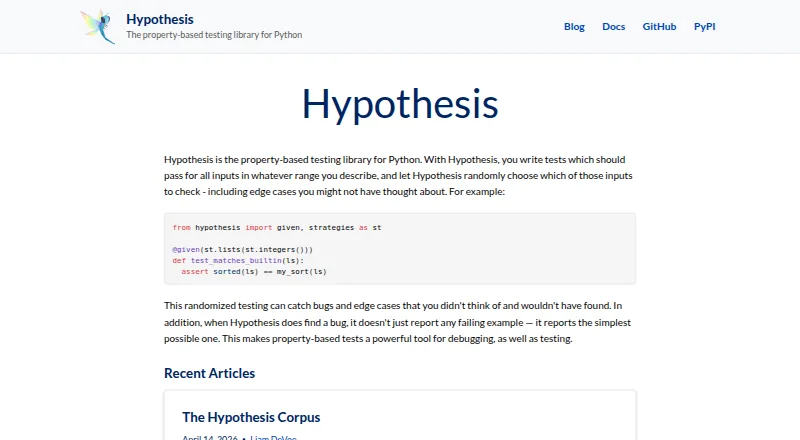
What Hypothesis is
Hypothesis is a free Python library for property-based testing. Instead of checking only examples chosen in advance, you describe behavior your code should satisfy and the library generates inputs—including edge cases—to explore those properties. Its strategies let you define and combine the kinds of data tests should use. When Hypothesis finds a failure, it reports an example and tries to reduce it to a simpler case; it saves failures in a local test database so they can be replayed in later runs. Tests run as regular Python functions inside a framework such as pytest or unittest, or another framework able to run a Python function. Hypothesis is not a test runner. It can also use rule-based state machines to generate operation sequences for testing stateful systems and objects. The default is 100 generated inputs per test, adjustable with max_examples. The project says it works on Linux, macOS, Windows and Emscripten, and supports CPython and PyPy 3.10 and later.
Good
- Generates inputs including edge cases.
- Attempts to simplify failing examples.
- Stores failures for replay in later runs.
- Supports pytest and unittest.
- State machines generate operation sequences.
Watch out
- It is not a test runner.
- Supports Python only.
- Only the most recent version is supported.
Who it suits
Hypothesis suits Python developers who want to specify acceptable behavior and let generated inputs probe their code. It is useful when tests need reproducible failures or sequences for stateful behavior.
Verdict
Hypothesis adds generated-input testing to an existing Python test framework, with saved failures and tools for stateful cases. Choose it if you want tests to explore beyond hand-picked examples; it does not replace your test runner.
The facts
Each one read from Hypothesis's own pages, with the date it was checked.
What it does
- Community help
- Users can ask questions using the python-hypothesis Stack Overflow tag or join the mailing list for help and discussion.checked 29 Sep 2026
- Compatibility limit
- The project supports only the most recent Hypothesis version; documented APIs are not expected to break except between major version bumps, while undocumented behavior may break in patch releases.checked 29 Sep 2026
- Data generation
- Its strategies let users describe and compose the kinds of data their tests should generate.checked 28 Sep 2026
- Default run count
- By default, Hypothesis generates 100 random inputs per test, and this count can be controlled with the max_examples setting.checked 29 Sep 2026
- Development model
- The maintainers say new features must be sponsored or implemented by someone else, and the project has no long-term release plan.checked 29 Sep 2026
- Edge cases
- Hypothesis randomly chooses inputs, including edge cases the user may not have considered.checked 29 Sep 2026
- Integrations
- First-party extras include integrations for specific packages, and the documentation gives Django as an example installable extra.checked 29 Sep 2026
- Intended users
- Hypothesis is for people writing software tests who want to describe acceptable behavior and have the computer explore inputs.checked 28 Sep 2026
- Operating systems
- The project says it is known to work and regularly tested on macOS, Windows, Linux, and Emscripten.checked 29 Sep 2026
- Python support
- Hypothesis is supported and tested on CPython and PyPy 3.10 and later.checked 29 Sep 2026
- Release availability
- The project describes publishing new packages to PyPI after changes are merged, usually within half an hour.checked 28 Sep 2026
- Repeatable failures
- Hypothesis saves failing examples in a local test database so it can replay them when tests run again.checked 28 Sep 2026
- Simplifies failures
- When Hypothesis finds a bug, it reports the simplest possible failing example.checked 29 Sep 2026
- Stateful testing
- Rule-based state machines let Hypothesis generate sequences of operations to test stateful systems and objects.checked 28 Sep 2026
- Test framework support
- Hypothesis works with pytest, unittest, nose, or another framework that can run a Python function.checked 28 Sep 2026
- Test runner limitation
- Hypothesis is not itself a test runner; it works inside a user's normal testing framework.checked 28 Sep 2026
- Test runners
- Hypothesis tests can run as regular Python functions and work with pytest or unittest.checked 29 Sep 2026
- Thread safety
- As of version 6.136.9, Hypothesis supports running the same test simultaneously from multiple threads.checked 28 Sep 2026
- What it does
- Hypothesis is a property-based testing library for Python that generates inputs within ranges described by the user.checked 29 Sep 2026
The full review of Hypothesis
Overview
Hypothesis is for Python developers who want tests to explore inputs beyond a hand-picked set of examples. Its generated cases, failure simplification and replay make property-based testing practical within a familiar test framework.
It is a focused testing library, not a complete testing environment: you still need a runner and must describe the behavior your code should satisfy.
Key features
Strategies and generated cases
Strategies define and compose the data a test can receive, letting you check a stated property against varied inputs, including edge cases. Hypothesis generates 100 random inputs per test by default; the max_examples setting lets you control that count. This gives a test broader reach than a fixed example set, though the cases depend on the properties and data you choose to describe.
Failures you can investigate and replay
When a generated input exposes a bug, Hypothesis reports it and tries to simplify the failing example. That can make an unexpected failure easier to diagnose than a complex input you assembled by hand. It also saves failing examples in a local test database and replays them on later runs, helping prevent a discovered problem from disappearing into a one-off run.
Framework and stateful testing
Hypothesis tests are ordinary Python functions, so they can run under pytest, unittest, nose or another framework that runs Python functions. First-party extras integrate with particular packages; Django is one example. For systems whose behavior depends on operation order, rule-based state machines generate sequences of operations against stateful objects. Hypothesis itself is not a runner, so it fits teams that already have a Python test setup rather than those seeking an all-in-one testing tool.
As of version 6.136.9, the same test can run simultaneously from multiple threads. The project says it regularly tests compatibility with CPython and PyPy 3.10 and later. It supports macOS, Windows, Linux and Emscripten, although the listed platforms for this entry are Linux, macOS and Windows.
Pricing
Hypothesis is free, with a free plan and no paid tier described. That makes it straightforward to adopt for individual developers or teams, but the project’s development model is not a promise of a long-term release schedule: maintainers say new features need sponsorship or implementation by someone else, and there is no long-term release plan.
New packages are published to PyPI after changes are merged, usually within half an hour. The project supports the most recent Hypothesis version; documented APIs are not expected to break except between major version bumps, while undocumented behavior can change in patch releases. Teams relying on undocumented behavior should account for that compatibility boundary.
Platforms
Hypothesis is a Python library for Linux, macOS and Windows. The project also reports regular testing on Emscripten. It is not a cross-language choice: Python is its supported language.
Who it's for
Choose Hypothesis if you write Python tests and want to express acceptable behavior once, then have generated inputs probe it for edge cases. It is especially useful when a system has stateful behavior that can be exercised through sequences of operations, or when preserving and simplifying failures would help your debugging process.
Look elsewhere if you need a test runner rather than a library, or if your codebase uses a language other than Python. Its help channels include the python-hypothesis tag on Stack Overflow and a mailing list.
Pros and cons
- Broader input exploration: Composable strategies and generated cases can expose edge cases absent from manually chosen examples.
- Actionable failures: Shrinking and local replay make generated bugs easier to inspect and keep in the test cycle.
- Fits existing Python tests: Support for common runners means adoption does not require replacing the test framework.
- Requires a runner and property descriptions: Hypothesis does not execute tests on its own, and generated coverage depends on the behavior and input strategies you define.
- Python-only, current-version support: Other languages need another tool, and users are expected to use the latest Hypothesis release.
Alternatives
For other language ecosystems, these free property-testing tools may fit better:
- Gopter is a free, MIT-licensed Go property-testing library for Linux and self-hosted use; choose it for Go rather than Python.
- RapidCheck is a free alternative for Linux, self-hosted and Windows platforms.
- fast-check is a free, MIT-licensed JavaScript/TypeScript project for API, Linux and web platforms; choose it for those languages instead of Python.
- Proptest is a free alternative listed for web use.
- QuickCheck is a free Haskell library for random testing of program properties on Linux; it is the language-specific choice for Haskell.
- Rapid is a free, open-source Go library with no dependencies outside Go’s standard library, for self-hosted use.
- SwiftCheck is a free option for macOS and iOS.
- CsCheck is another free alternative.
Browse the Property-Based Testing Tools list for more options.
Verdict
Hypothesis is a strong fit for Python developers who want tests to discover, simplify and preserve surprising inputs without changing their runner. Its biggest advantage is that complete cycle from generated case to replayable failure; its main limitation is the same focus that makes it effective: it is a Python testing library, not a runner or a cross-language solution.
Alternatives to Hypothesis
- 1

fast-check
Free planOpen sourceWebAPILinuxSelf-hosted7.1Free plan - 2
ScalaCheck
Free planLinuxmacOSWindows6.6Free plan - 3
Gopter
Free planLinuxSelf-hosted6.4Free plan - 4
JSVerify
Free planWebSelf-hosted6.4Free plan - 5
Racket QuickCheck
Free planLinuxmacOSWindows6.4Free plan - 6
FsCheck
Free planLinuxmacOSWindows6.3Free plan