Hauk
Hauk is a free, open-source service for sharing a phone’s live location through a self-hosted backend.
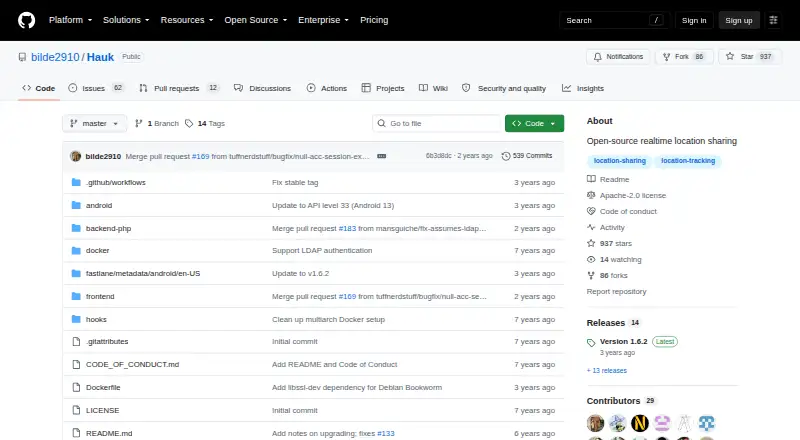
What Hauk is
Hauk is a free, open-source service for sharing a phone’s live location through a self-hosted backend. A user can set a sharing period and send a link that lets others follow their location on a map; the share ends when its time expires or the user stops it. Anyone with the link can see the location while sharing is active. The Android app sends location data only to the Hauk server configured by the user, so using it requires installing the backend on a server. That server needs PHP and Memcached or Redis, with the matching PHP extensions. Deployment options include manual or scripted installation, an Arch Linux AUR package, and an official Docker image. Hauk supports end-to-end encryption and LDAP authentication; the app also supports HTTP and SOCKS proxies. The project recommends HTTPS through a reverse proxy because unencrypted traffic can expose location data in transit. It is licensed under Apache-2.0. The public demo is for demonstration and limits shares to two minutes.
Good
- Free and open source under Apache-2.0
- Location data goes only to the configured server
- Offers Docker and Arch Linux deployment options
- Supports end-to-end encryption and LDAP authentication
Watch out
- Requires a PHP server and Memcached or Redis
- Anyone with the link can see an active share
- The public demo limits shares to two minutes
Who it suits
Hauk suits people who want to share live location with friends or family and are prepared to run the required backend. It is intended for Android location sharing with a server the user specifies.
Verdict
Hauk gives users control over the server receiving location data, but requires backend setup and careful HTTPS configuration. Anyone holding an active share link can view the location.
Plans and prices
From Hauk's own pricing page, checked 11 Oct 2026.
| Plan | Price | What it gives you |
|---|---|---|
| Hauk | Free | Self-hosted; requires a PHP web server and Memcached or Redis |
The facts
Each one read from Hauk's own pages, with the date it was checked.
Where it runs
- Android availability
- The companion app is available for Android; the listed F-Droid version 1.6.2 requires Android 7.0 or newer.checked 4 Oct 2026
- Supported Android version
- The README lists Android 6 or later as the requirement for its companion app.checked 11 Oct 2026
What it does
- Authentication
- The project supports password-protecting session creation and LDAP authentication.checked 11 Oct 2026
- Backend requirement
- Using the Android app requires installing the Hauk backend on a server.checked 4 Oct 2026
- Backend requirements
- The server needs PHP and Memcached or Redis, with the corresponding PHP extension installed.checked 11 Oct 2026
- Data destination
- The app sends location data only to the Hauk backend server specified in the app.checked 4 Oct 2026
- Deployment options
- The project documents manual or scripted installation, an Arch Linux AUR package, and an official Docker image.checked 4 Oct 2026
- Distribution
- The backend is available as an Arch Linux AUR package and as an official Docker image.checked 11 Oct 2026
- Encryption
- The project supports end-to-end encryption, and its Docker guidance recommends exposing Hauk only through HTTPS because unencrypted traffic can reveal location data.checked 11 Oct 2026
- How it works
- Users install the backend on a PHP-compatible web server and use the companion Android app to share location.checked 11 Oct 2026
- How sharing works
- A phone user can share their live location for a specified period and send a link that lets others follow them on a map.checked 4 Oct 2026
- Integration
- Hauk supports starting shares via Tasker.checked 11 Oct 2026
- Integrations
- The Android app supports HTTP and SOCKS proxies, and the backend supports LDAP authentication.checked 4 Oct 2026
- Intended users
- The project describes sharing location with friends and family, such as sending a link to someone you are meeting.checked 4 Oct 2026
- License and funding
- The repository uses the Apache-2.0 license, and its maintainer describes Hauk as an ad-free project made without financial gain while accepting donations.checked 11 Oct 2026
- License and support
- Hauk is distributed under the Apache-2.0 license, and the repository provides an issue tracker for project issues.checked 4 Oct 2026
- Link access
- Anyone with a share link can see the location in real time while sharing is active.checked 4 Oct 2026
- Live location
- A share remains active until it expires or the user stops it.checked 11 Oct 2026
- Notable limit
- The public demo server limits location shares to two minutes and is intended for demonstration.checked 4 Oct 2026
- Product
- Hauk is an open-source, self-hosted realtime location sharing service.checked 11 Oct 2026
- Security
- The project recommends using a reverse proxy with TLS and exposing Hauk only over HTTPS because unencrypted traffic can expose location data in transit.checked 4 Oct 2026
- Sharing access
- Anyone with the sharing link can see the shared location, and the default link uses eight randomly generated letters and numbers.checked 11 Oct 2026
- Storage
- Hauk keeps location data in Memcached in memory rather than saving it to disk; restarting Memcached removes the data.checked 11 Oct 2026
The company
- Maker
- The repository owner identifies as Marius Lindvall and lists Norway as their location.checked 11 Oct 2026
The full review of Hauk
Overview
Hauk is a free, open-source service for sharing a live location through a link, using a server you operate. It suits technically confident Android users who want control over where location data goes and are comfortable running that server. Its privacy-minded design comes with a real trade-off: setup and secure deployment are your responsibility.
Key features
Sharing starts in the Android companion app: choose a duration, then send a link so someone can follow your position on a map. A share ends when its time expires or you stop it. This is a focused way to coordinate a meeting with friends or family, not a location-history service; Hauk has no location history.
Hauk sends location data only to the backend server specified in the app. The default share link contains eight randomly generated letters and numbers, but anyone who has the link can see the live location while sharing remains active. Treat the link like access credentials and share it selectively.
Location data is kept in Memcached in memory rather than written to disk, and restarting Memcached removes it. The project supports end-to-end encryption and recommends exposing Hauk only over HTTPS through a reverse proxy: unencrypted traffic can reveal location data in transit. LDAP authentication is available as a backend option, and the Android app supports HTTP and SOCKS proxies. Tasker support lets users start shares through an automation.
The public demo server is limited to two-minute shares and is intended for demonstration, not as a substitute for deploying your own backend.
Pricing
Hauk costs nothing. Its free, open-source offering is self-hosted rather than a hosted service: the plan requires a PHP web server and Memcached or Redis, along with the corresponding PHP extensions. There is no free trial; the project is free under the Apache-2.0 license.
There are no paid tiers or seat and quota terms to weigh. The cost instead is operational: you provide and maintain the server. Donations are accepted, but the maintainer describes the project as ad-free and made without financial gain.
Platforms
The companion app is for Android, and the service runs on a self-hosted Linux or other PHP-compatible web server, with a web map for people opening a share link. The README says Android 6 or later; the listed F-Droid version 1.6.2 requires Android 7.0 or newer, so check the version you intend to install against your device.
Deployment choices include documented manual or scripted installation, an Arch Linux AUR package, and an official Docker image. Each route still leaves server configuration to you.
Who it's for
Hauk is a good fit for Android users who want to share a temporary live location without routing it through a service provider's server, and who can set up a PHP backend with Memcached or Redis. It is less suitable for anyone who wants a ready-to-use family locator, iOS support, location history, or a service that handles hosting and secure configuration for them.
Pros and cons
- Pros: Self-hosting lets you choose the server that receives location data.
- Pros: In-memory storage avoids retaining location data on disk; restarting Memcached clears it.
- Pros: Free, open-source software with documented deployment options, LDAP support, proxies, and Tasker integration.
- Cons: The backend and its PHP and cache requirements make setup more involved than using a hosted location-sharing app.
- Cons: Anyone with an active share link can view the location, so link handling matters.
- Cons: Secure use calls for HTTPS and a reverse proxy; an incorrectly exposed server can put location data at risk in transit.
- Cons: Android-only companion app and no location history limit its appeal for households using mixed platforms or wanting past routes.
Alternatives
For more family-locator choices, browse Family Locator Apps.
- Family Locator is the better fit if you want Android, iOS, or macOS support and a free version with complete functionality; its one-time Lifetime plan is 14.99 USD for premium features.
- Findmykids suits readers who want Android, iOS, or web access and a freemium service, with a free Básico plan and a Cuidar plan at €3.58 a month, billed 42,99 €.
- iSharing is worth considering for Android, iOS, or web users who want place alerts, a seven-day history and driving report after watching an ad, and standard SOS in its free tier.
- Glympse is an alternative for Android, iOS, API, or web users; its mobile app is free, while Glympse PRO starts at $15 a month.
- OpenFamily is another free, self-hosted option for Android, iOS, API, and web, distributed under AGPL-3.0.
- OtoZen offers Android and iOS access with a free plan that includes two days of drive history and two places.
- Be Closer offers free real-time location on Android and iOS, with a $3.99 a month Premium plan that includes unlimited location history.
- BuddySOS is a free Android and iOS option for one group and one safe zone, with a $1.99 a month Pro plan for more groups and zones and no ads.
Verdict
Choose Hauk if you use Android, want to decide which server receives location data, and can run and secure a backend yourself. Its strongest reason to choose it is that control; its clearest reason to look elsewhere is the work and care required to host it safely, especially if you need a polished, multi-platform family locator or location history.
Getting started
- Install the backend on a PHP-compatible web server.
- Provide Memcached or Redis and the corresponding PHP extensions.
- Choose manual or scripted installation, the Arch Linux AUR package, or the official Docker image.
- Install the Android companion app and specify your Hauk backend server.
- Set up HTTPS through a reverse proxy with TLS before sharing location.
- Choose a sharing period and send the link to the people who should follow the location.
Limits worth knowing
Hauk has no paid plan. Its public demo server limits location shares to two minutes and is intended for demonstration; the Android app requires a self-hosted backend for normal use.
Questions
Is Hauk free?
Yes. The Hauk plan costs nothing and is self-hosted.
Which platforms are supported?
The companion app is for Android, and the service uses a web-accessible backend hosted on a server.
What does the backend require?
It requires a PHP web server and Memcached or Redis, along with the corresponding PHP extensions.
Is Hauk open source?
Yes. Hauk is distributed under the Apache-2.0 license.
Who can see a shared location?
Anyone with the share link can see the location in real time while sharing is active.
Who makes Hauk?
The repository owner identifies as Marius Lindvall and lists Norway as their location.
Alternatives to Hauk
- 1

OpenFamily
Free planOpen sourceAndroidiOSWebAPI7.7Free plan - 2

BuddySOS
Free planAndroidiOS7.6From $19.99 a year - 3

Findmykids
Free planAndroidiOSWeb7.2From €3.58 a month - 4
Family Locator
Free planAndroidiOSmacOS7.1From $19.99 a month - 5

Glympse
Free planAndroidiOSWebAPI7.1From $15 a month - 6
CircleUs
Free planAndroidiOS6.9From $9 a month