
Grizz Technographics
Grizz Technographics identifies software used by construction companies, helping sales and marketing teams find accounts based on their technology.
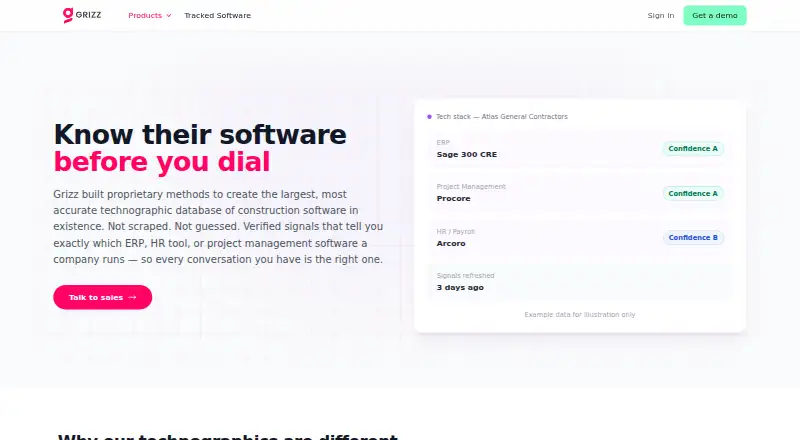
What Grizz Technographics is
Grizz Technographics identifies software used by construction companies, helping sales and marketing teams find accounts based on their technology. It tracks more than 100 construction technologies and lists over one million technology signals. Categories include ERP, project management, accounting, HR, payroll, estimating, and field tools. Each signal has an A, B, or C confidence grade reflecting the strength and corroboration of its supporting signals. Grizz says it analyzes construction job postings daily and refreshes signals weekly; historical timelines show when companies changed software. Users can review an account’s technology stack, filter for companies using a competitor’s product, and identify companies evaluating or implementing software. Data can be sent to CRM records through CSV or the API, including HubSpot and Salesforce. The API is in early access, and its endpoints and response shapes may change. Free access offers sample data and limited technology and company details; Premium provides deeper data and a white-glove partnership, with pricing by discussion. The EULA permits internal business use and CRM enrichment but bars resale and competing data products.
Good
- Tracks more than 100 construction technologies.
- Historical timelines show software changes.
- Filters companies by competitor software use.
- Exports data through CSV or API.
- Free tier has no credits or usage meters.
Watch out
- Free access provides limited technology and company data.
- Premium pricing is by discussion.
- API endpoints and response shapes may change.
- Data may be incomplete, outdated, or erroneous.
Who it suits
Grizz Technographics suits sales and marketing teams looking for construction companies that use specific business software. It offers web and API access, with free sample data and a Premium option for deeper data.
Verdict
Grizz Technographics focuses on software signals for construction-company prospecting and CRM enrichment. Consider the confidence grades, data caveat, and usage restrictions before relying on the information or sharing it.
Plans and prices
From Grizz Technographics's own pricing page, checked 4 Oct 2001.
| Plan | Price | What it gives you |
|---|---|---|
| Free | Free | Sample data · Limited tech stack data, company descriptions, phone/location, and enhanced company insights · No credits or usage meters |
| Premium | Priced on request | Deeper data · White-glove partnership · Pricing by discussion |
The facts
Each one read from Grizz Technographics's own pages, with the date it was checked.
What it does
- API access
- The Grizz API uses bearer-token authentication, is available to users with domain admin access, and is described as early access with endpoints and response shapes subject to change.checked 4 Oct 2001
- API output
- The Audience Builder API returns matching company lists as JSON or CSV, including company identifiers, location, employee and revenue ranges, and technology fields.checked 4 Oct 2001
- Confidence scores
- Each technographic signal has a confidence grade; the page describes Grade A as confirmed by multiple independent signals and Grade B as a strong indication with fewer corroborating sources.checked 3 Oct 2001
- Coverage
- The product page states that Grizz tracks more than 100 construction technologies and has over 1 million tech signals in its database.checked 4 Oct 2001
- CRM export
- Technographic data can be exported by CSV or sent through the Grizz API to CRM records, including HubSpot and Salesforce.checked 4 Oct 2001
- Data accuracy caveat
- The EULA says data may be incomplete, outdated, or erroneous, and that Grizz does not guarantee its accuracy or completeness.checked 4 Oct 2001
- Data collection
- Grizz says it uses proprietary collection and verification methods rather than licensing the technographic data from a reseller.checked 4 Oct 2001
- Data use terms
- The EULA permits internal sales, marketing, analytics, and operational use, and prohibits reselling the data or using it to create a competing data product.checked 3 Oct 2001
- Historical data
- Grizz provides historical timelines that show when companies switched software.checked 4 Oct 2001
- History
- The database includes historical timelines showing when companies switched software.checked 3 Oct 2001
- Intended users
- Grizz describes the product as helping sales and marketing teams identify companies using specific business software.checked 3 Oct 2001
- Premium access
- The pricing page describes Premium as deeper data with a white-glove partnership and directs customers to contact sales for details.checked 4 Oct 2001
- Prospecting
- Users can filter for companies running a specific competitor’s software and build a list of those customers.checked 3 Oct 2001
- Purpose
- Grizz helps sales teams identify construction companies by the ERP, HR, payroll, and project management software they use.checked 4 Oct 2001
- Refresh cadence
- The product page says signals are refreshed weekly and describes analyzing thousands of construction job postings each day.checked 4 Oct 2001
- Signal scoring
- Each technographic record has an A, B, or C confidence score, with grades reflecting the strength and corroboration of the signals.checked 4 Oct 2001
- Signal updates
- Grizz says it analyzes construction job postings daily to detect stack changes, implementations, and displacement opportunities; the page lists a weekly signal refresh cadence.checked 3 Oct 2001
- Software categories
- Tracked categories include ERP, project management, accounting, HR, payroll, estimating, and field tools.checked 3 Oct 2001
- Technology index
- The tracked technology page offers a preview, while full company confirmations and signal data are available on premium plans.checked 3 Oct 2001
- Usage restrictions
- The EULA permits internal business use and CRM enrichment but prohibits reselling or distributing the data and using it to build a competing data product.checked 4 Oct 2001
- Use cases
- Users can view an account’s tech stack, find companies using a competitor’s product, and spot companies evaluating or implementing software.checked 4 Oct 2001
The company
- Company identity
- The EULA identifies the operator as Grizz Inc.checked 3 Oct 2001
Money
- Plan limits
- The free tier includes sample data and limited technology, company description, phone/location, and enhanced company insight data; the pricing page says it has no credits or usage meters.checked 4 Oct 2001
The full review of Grizz Technographics
Overview
Grizz Technographics identifies software used by construction companies, from ERP systems to field tools, using signals such as job postings. It is best suited to sales and marketing teams prospecting construction accounts or enriching CRM records. Its construction-specific focus and historical, confidence-graded signals are useful, but full data is a premium purchase and the API remains in early access.
Key features
Grizz tracks more than 100 construction technologies across ERP, project management, accounting, HR, payroll, estimating, and field tools, with over one million signals in its database. That specialization can make it a better fit for construction prospecting than a broad technology lookup when the target is a company’s business software stack. The technology index provides a preview; full company confirmations and signal data require premium access.
Records receive an A, B, or C confidence grade reflecting signal strength and corroboration. Grade A is backed by multiple independent signals; Grade B is a strong indication with fewer corroborating sources. Grizz analyzes construction job postings daily for changes, implementations, and displacement opportunities, while the stated signal refresh cadence is weekly. Historical timelines show when a company switched software. Together, these features help teams prioritize accounts and identify possible buying activity, though they do not make every signal definitive.
Users can view an account’s stack, filter for companies using a competitor’s software, and identify companies evaluating or implementing tools. Data can be exported to CRM records through CSV or the Grizz API, with HubSpot and Salesforce named as destinations. The Audience Builder API returns matching company lists as JSON or CSV, including identifiers, location, employee and revenue ranges, and technology fields. API access requires domain admin access and bearer-token authentication; early-access endpoints and response shapes may change, a consideration for teams building a durable integration.
The EULA permits internal sales, marketing, analytics, operational use, and CRM enrichment. It bars reselling or distributing the data and using it to build a competing data product. Grizz says it collects and verifies the data through proprietary methods rather than licensing it from a reseller, but its EULA still warns that records may be incomplete, outdated, or erroneous and makes no guarantee of accuracy or completeness.
Pricing
The Free plan costs nothing. It includes sample data and limited technology-stack data, company descriptions, phone and location details, and enhanced company insights, with no credits or usage meters. That makes it a low-friction way to explore the product, but the sample and limited data do not replace the full company confirmations needed for systematic prospecting.
Premium has custom pricing. It includes deeper data and a white-glove partnership, with pricing by discussion. It is the relevant tier for teams that need full signal access, but buyers must contact sales to establish the cost and scope.
Platforms
Grizz is available on web and through an API. The web option suits teams researching accounts directly; API access supports programmatic audience building and CRM enrichment, with early-access changes worth accounting for before making it central to a workflow.
Who it's for
Grizz is aimed at sales and marketing teams that target construction companies, especially those looking for accounts running a competitor’s product or tracking changes to a target account’s software. Its category coverage and historical signals are most relevant when construction software adoption is a meaningful prospecting cue. Teams seeking broad, unrestricted data distribution or a stable, production-ready API should look elsewhere.
Pros and cons
- Pros: Construction-specific coverage spans more than 100 technologies and several core business-software categories, giving prospecting teams a focused view of relevant accounts.
- Pros: Confidence grades, weekly refreshes, and historical switching timelines add useful context for prioritizing leads rather than treating every match equally.
- Pros: CSV and API exports, including HubSpot and Salesforce destinations, provide routes into sales workflows.
- Cons: The free plan is limited and premium data requires a sales discussion, so teams cannot assume that the free tier supports full-scale prospecting.
- Cons: The EULA disclaims accuracy and completeness, which means signals warrant validation before they drive important decisions.
- Cons: Early-access API endpoints and response shapes can change, creating integration uncertainty.
Alternatives
Technographic Data Software is a useful starting point for comparing tools in the category. Choose Wappalyzer instead if its freemium plan, free trial, and support across web, mobile, extension, API, and self-hosted platforms suit your needs; its free tier includes 50 technology lookups per month. BuiltWith offers a free allowance of 10 detailed lookups per day and an Advanced plan at $144 a year, billed with a one-year minimum, for unlimited detailed lookups.
Datanyze is another option, with a 90-day trial and credit-based plans. BuyerCaddy may suit teams that prefer a token-based free tier, which includes 1000 tokens for a single user. NerdyData offers a free account with reports of up to 500 rows and a free API account. PredictLeads is an alternative for teams looking at API-call-based plans. Pursued.io has a free plan with 50 credits and one team member. TechnologyChecker offers 100 lookups per month, six months of historical data, single-result CSV export, and basic company enrichment on its free plan.
Verdict
Choose Grizz if your team prospects construction companies and needs software-stack signals, switching history, and CRM-oriented exports in one focused workflow. Its strongest case is the combination of construction-specific coverage and confidence context. Look elsewhere if you need complete data on a free tier, guaranteed data accuracy, unrestricted redistribution, or an API whose interface is no longer in early access.
Getting started
- Open the Grizz Technographics website
- Create a free account for sample data or contact sales about Premium
- Search company profiles and review technology confidence grades
- Filter for competitor users or technology intent signals
- Export results as CSV or use the API with domain-admin access and bearer authentication
- Send data to CRM records such as HubSpot or Salesforce
Limits worth knowing
The Free plan includes sample data with limited technology-stack, company-description, phone/location, and enhanced-company-insight data, with no credits or usage meters. Premium provides deeper data through a white-glove partnership, with pricing discussed with sales.
Questions
Is there a free plan?
Yes. Free costs nothing and includes sample data with limited technology and company information, phone/location details, and enhanced insights.
What does Premium include?
Premium offers deeper data and a white-glove partnership. Pricing is by discussion with sales.
Which platforms are available?
Grizz Technographics is available on the web and through an API.
Can data be exported to a CRM?
Yes. Data can be sent through CSV or the Grizz API, including to HubSpot and Salesforce records.
What are the API requirements?
API access requires domain-admin access and bearer-token authentication. Grizz describes the API as early access, so endpoints and response shapes may change.
May the data be resold?
No. The EULA permits internal sales, marketing, analytics, operational use, and CRM enrichment, but prohibits reselling or creating a competing data product.
Alternatives to Grizz Technographics
- 1
Datanyze
Free planWebExtension7.5Free plan - 2

PredictLeads
Free planWebAPIExtensionSelf-hosted7.5From $0.01 a month - 3

Wappalyzer
Free planAndroidiOSWebAPI7.5From $250 a month - 4

BuyerCaddy
Free planWebAPIExtension7.3From $1,000 a month - 5

BuiltWith
Free planWebAPIExtension7.2From $12 a month - 6

B2BEnrich
Free planWebAPI6.8From $49 a month