
Global Relay Event Archiving API
Global Relay Event Archiving API sends social media, collaboration, and customer experience activity into Global Relay Archive for discovery and analysis.
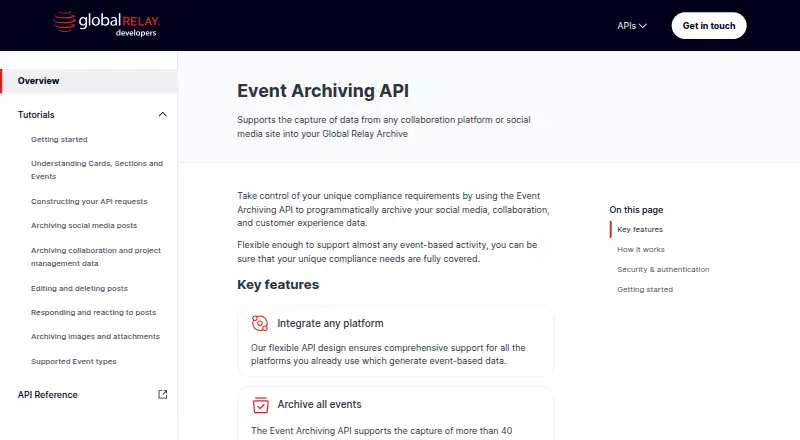
What Global Relay Event Archiving API is
Global Relay Event Archiving API sends social media, collaboration, and customer experience activity into Global Relay Archive for discovery and analysis. It supports more than 40 event types, such as posts, replies, and profile updates, and is designed for platforms that produce event-based data. Global Relay authenticates, validates, transforms, and stores submitted data. Applications must be registered and name the data types they will archive before making calls. Authentication uses OAuth 2.0 Client Credentials, and endpoints require HTTPS. Any language with an HTTP library can work with the API. Each source platform requires its own credentials; for example, Jira and LinkedIn need separate sets. Attachments must be uploaded to the files endpoint before an event can refer to them. Global Relay lists connectors for services including Microsoft Teams, Slack, Salesforce Chatter, Zoom, and Webex. Archive features include configurable retention, legal hold, advanced search, and export to PST or EML, or via FTP, DVD, or hard drive. Pricing is available on request.
Good
- Supports more than 40 event types.
- Uses OAuth 2.0 Client Credentials authentication.
- Offers configurable retention, legal hold, and advanced search.
- Supports PST and EML exports.
- Lists connectors for collaboration and social platforms.
Watch out
- Pricing is available on request.
- Enrollment is required before API use.
- Each source platform needs separate credentials.
- Attachments must be uploaded before event references.
Who it suits
It suits organizations archiving communications across platforms, particularly those in financial and other highly regulated industries. Developers need to account for enrollment and separate credentials for each platform.
Verdict
The API provides a structured route for archiving event-based communications across supported sources. Plan for application registration, platform-specific credentials, and the requested pricing model.
Plans and prices
From Global Relay Event Archiving API's own pricing page, checked 30 Sep 2026.
| Plan | Price | What it gives you |
|---|---|---|
| Event Archiving API | Priced on request | application enrollment required · credentials per platform/data type |
The facts
Each one read from Global Relay Event Archiving API's own pages, with the date it was checked.
What it does
- Archive workflow
- Global Relay authenticates, validates, transforms, and stores submitted data in Global Relay Archive, where archive users can discover and analyze it.checked 30 Sep 2026
- Attachments
- File attachments must be uploaded to the PUT /files endpoint before they are referenced in an event request.checked 30 Sep 2026
- Authentication
- The API uses OAuth 2.0 Client Credentials grant authentication.checked 30 Sep 2026
- Certifications
- Global Relay’s Trust Portal displays SOC 2 Type II, ISO 27001, GDPR, and CCPA badges.checked 30 Sep 2026
- Compliance archive
- Global Relay says archived content is stored in a WORM-compliant, tamper-proof format with continuous integrity checks, chain-of-custody tracking, and encrypted storage.checked 30 Sep 2026
- Credential scope
- A new credential set is required for every platform from which data is archived; Global Relay gives Jira and LinkedIn as examples requiring separate credentials.checked 30 Sep 2026
- Custom integration
- Global Relay Archive supports any communication data source using a standardized open-source format and secure SMTP delivery, with custom integrations available.checked 30 Sep 2026
- Encryption
- Global Relay states that data is end-to-end encrypted in transit and at rest.checked 30 Sep 2026
- Enrollment
- Applications must be registered and specify the data types they plan to archive before calling the API.checked 30 Sep 2026
- Event types
- The API supports more than 40 event types, including posts, replies, profile updates, and other user activity.checked 30 Sep 2026
- Integrations
- Global Relay lists connectors for platforms including Jira Cloud, LinkedIn, Microsoft Teams, Slack, Salesforce Chatter, WhatsApp Business, Zoom, and Webex.checked 30 Sep 2026
- Purpose
- The API programmatically archives social media, collaboration, and customer experience data into Global Relay Archive.checked 30 Sep 2026
- Support
- Global Relay provides technical support, training, professional services, and 24/7 expert advice and support.checked 30 Sep 2026
- Target customers
- Global Relay describes its solutions as serving the global financial sector and other highly regulated industries.checked 30 Sep 2026
- Transport
- Global Relay API endpoints require HTTPS and conform to HTTP/1.1, and the Event Archiving API works with any language that has an HTTP library.checked 30 Sep 2026
The company
- Founded
- 1999checked 28 Sep 2026
- Headquarters
- Vancouver, British Columbia, Canadachecked 28 Sep 2026
Where it runs
- Platform coverage
- The API is designed to support platforms that generate event-based data, including collaboration platforms and social media sites.checked 30 Sep 2026
The full review of Global Relay Event Archiving API
Overview
Global Relay Event Archiving API routes event-based social, collaboration and customer experience data into Global Relay Archive. It suits organizations that need to capture communications across supported platforms, particularly in regulated industries. Its broad event coverage and archive controls are compelling, but implementation requires platform-by-platform credentials and application enrollment.
Key features
The API accepts more than 40 event types, from posts and replies to profile changes and other user activity. Global Relay authenticates, validates and transforms submitted data before storing it in its archive, where users can discover and analyze it. That gives teams a way to bring varied platform activity into a central archive; the API’s scope is event data, not a turnkey archiving workflow that avoids integration work.
Enrollment comes first: applications must be registered and declare the data types they intend to archive. Each platform needs its own credential set, so a Jira connection and a LinkedIn connection, for example, are separate setup tasks. OAuth 2.0 Client Credentials handles authentication. Endpoints require HTTPS and follow HTTP/1.1, and any language with an HTTP library can make requests, which leaves implementation language open.
Attachments require an additional step: upload each file to the PUT /files endpoint before referencing it in an event request. Global Relay lists connectors for Jira Cloud, LinkedIn, Microsoft Teams, Slack, Salesforce Chatter, WhatsApp Business, Zoom and Webex. For other communication sources, it supports standardized open-source formats and secure SMTP delivery, with custom integrations available. That flexibility may help organizations with unusual sources, though custom connections add integration work.
Archived content is kept in a WORM-compliant, tamper-proof format, with continuous integrity checks, chain-of-custody tracking and encrypted storage. Global Relay states that data is end-to-end encrypted in transit and at rest. The service also supports configurable retention, legal hold, advanced search and export in PST or EML, with delivery by FTP, DVD or hard drive. These controls suit record-keeping and discovery needs; their value depends on the organization’s specific obligations and workflow.
Pricing
Event Archiving API
This paid plan has custom pricing. Application enrollment is required, and credentials are needed for each platform and data type. No seat or event quota is given. The plan’s fit depends on the sources to be connected and the pricing Global Relay offers; organizations should confirm the cost and scope before committing.
Retention is configurable, and legal hold, advanced search and the stated export options are part of the archive capabilities. No trial or renewal term is given.
Platforms
The API is categorized for web and API use. It works over HTTPS with any programming language that has an HTTP library, rather than being tied to one development language. Global Relay’s connector list covers a mix of collaboration, social and customer communication services, including Teams, Slack, LinkedIn, Salesforce Chatter, WhatsApp Business, Zoom and Webex.
Who it's for
This is best suited to organizations that need to archive communications from multiple event-generating platforms into Global Relay Archive and can support the enrollment and integration process. Global Relay positions its solutions for the financial sector and other highly regulated industries. Teams seeking a ready-to-use, low-setup social archiving app should look elsewhere: the per-platform credentials, declared data types and attachment upload step make this an integration-led choice.
Pros and cons
Pros
- Broad event coverage: More than 40 event types can bring varied user activity into the archive.
- Flexible integration approach: HTTP-library compatibility, a range of listed connectors and custom integration options accommodate different technical environments.
- Archive controls: Configurable retention, legal hold, advanced search and integrity tracking support retention and discovery workflows.
Cons
- Setup is source-specific: Registration and separate credentials for each platform make connecting multiple sources a real implementation task.
- Attachments add a step: Files must be uploaded before event requests can reference them.
- Cost requires a request: Custom pricing makes it harder to compare budgets before discussing scope with Global Relay.
Alternatives
For a broader starting point, browse Social Media Archiving Software. Consider Intradyn Social Media Archiving or MirrorWeb Insight as paid, web-based alternatives. MessageWatcher Social Media Compliance is another web-based paid option; its LinkedIn Personal plan costs $10 a month per account, while social media archiving costs $30 a month per account, and it offers a free trial.
SND Archive is a web-based paid alternative with customized pricing and demo requests. ZL UA for Social Media Archiving is another paid option. Brolly is paid and web-based, with no free plan. For a free-plan option with web, macOS, iOS and Android coverage, consider Social Archiver. Archive Intel is paid, has no free plan or free trial, and runs on Android, iOS and web; its platform plan is $99 a month, plus connector and text-archiving charges, with 1TB storage included and no minimums.
Verdict
Choose Global Relay Event Archiving API if your organization needs event-based communications archived in Global Relay Archive and can manage source-specific enrollment and integration. Its event breadth and compliance-oriented archive controls are the strongest reasons to choose it. Look elsewhere if you need transparent upfront pricing or a social archiving service with less integration work.
Alternatives to Global Relay Event Archiving API
- 1
Social Archiver
Free planOpen sourceAndroidiOSWebExtension8.4From $39.99 a year - 2

Jatheon Cloud
AndroidiOSWebAPI7.5From $60 a month - 3
Tweet Archivist
WebWindows7.1From $290 a year - 4
Page Vault Browser
WebAPIExtensionmacOS7.0$149 one-time - 56.7From $5,000 a year
- 6

Archive Intel
AndroidiOSWeb6.6From $99 a month