
Fission
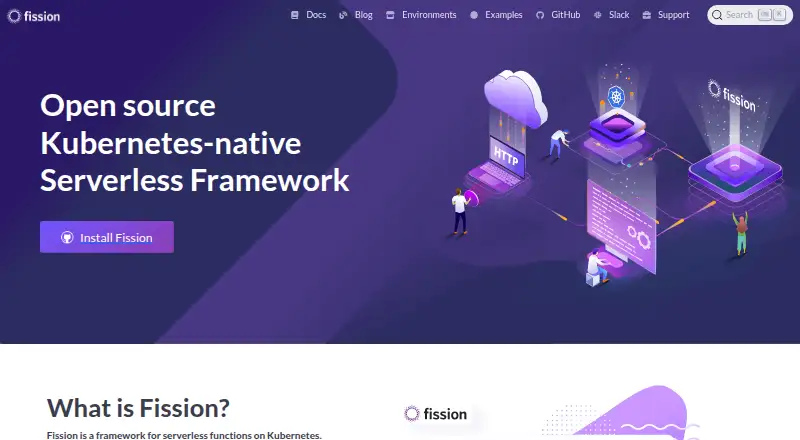
The facts below are what the maker publishes about Fission, checked and dated. Our editors have not written about it yet.
The facts
Each one read from Fission's own pages, with the date it was checked.
Where it runs
- CLI platforms
- The installation guide provides CLI installation instructions for macOS, Linux, and Windows.checked 4 Oct 2026
What it does
- Cold starts
- Fission keeps warm containers available, with typical cold starts around 100 milliseconds.checked 5 Oct 2026
- Deployment
- Fission deploys functions with one command without requiring users to build containers or manage Docker registries.checked 4 Oct 2026
- Deployment options
- Fission runs on Kubernetes clusters on a laptop, in a public cloud, or in a private data center.checked 5 Oct 2026
- Developer workflow
- Fission supports declarative specifications that can be checked into source control and used to recreate an application.checked 5 Oct 2026
- Event sources
- The docs list message queue trigger integrations for Apache Kafka, AWS SQS, AWS Kinesis, GCP Pub/Sub, NATS, RabbitMQ, and Redis Lists.checked 5 Oct 2026
- Function deployment
- Fission maps short-lived functions to HTTP requests or other event triggers and deploys them with one command, without requiring users to build containers or manage Docker registries.checked 5 Oct 2026
- Integrations
- The homepage says Fission integrates with Fluentd for CLI logs, Prometheus for metrics, and Istio for service mesh monitoring and tracing.checked 5 Oct 2026
- Intended use
- The homepage describes building serverless API backends, implementing webhooks, and writing Kubernetes event handlers as Fission use cases.checked 5 Oct 2026
- Kubernetes requirement
- Fission v1.27.0 requires Kubernetes 1.32 or higher.checked 4 Oct 2026
- Languages
- The documentation lists Node.js, Python, Go, Ruby, PHP, Bash, and custom container images as supported runtimes.checked 5 Oct 2026
- License
- Fission is open source under the Apache License.checked 5 Oct 2026
- Observability integrations
- Fission integrates with Fluentd for logs, Prometheus for metrics, and Istio for service mesh monitoring and request-latency tracing.checked 4 Oct 2026
- Portability
- Fission runs on Kubernetes clusters on laptops, public clouds, or private data centers.checked 4 Oct 2026
- Product
- Fission is an open source framework for running serverless functions on Kubernetes.checked 5 Oct 2026
- Queue integrations
- KEDA-backed queue connectors include Kafka, NATS JetStream, RabbitMQ, Redis, AWS SQS, AWS Kinesis, and GCP Pub/Sub.checked 4 Oct 2026
- Security
- Function invocation authentication is optional and can be enabled on the Fission Router using tokens passed in an Authorization header.checked 5 Oct 2026
- Support
- The project directs users to its Slack community and provides troubleshooting guides and a CLI command for collecting support diagnostics.checked 5 Oct 2026
- Support and community
- The site invites users to join its Slack community to interact with the team, other users, and contributors.checked 4 Oct 2026
- Tenant isolation
- The multi-namespace tenancy guide says each onboarded namespace receives its own narrow RBAC permissions and derived signing key.checked 5 Oct 2026
- Triggers
- Documented trigger types include HTTP, timers, message queues through KEDA, and Kubernetes watches.checked 5 Oct 2026
- What it does
- Fission is an open-source framework for running serverless functions on Kubernetes and mapping them to HTTP requests or other event triggers.checked 4 Oct 2026
- Who it is for
- Fission describes use cases including serverless API backends, webhooks, and handlers for Kubernetes resource changes.checked 4 Oct 2026
Alternatives to Fission
- 1

Inngest
Free planOpen sourceWebAPILinuxmacOS8.3From $99 a month - 2
OpenFaaS
Free planWebAPILinuxmacOS7.1From $1,250 a month - 3

Val Town
Free planWebAPI6.9From $252 a year - 4

Koyeb
Free planWebAPI6.8From $29 a month - 5

Restate
Free planWebAPISelf-hosted6.8$75 usage-based - 6
Trigger.dev
Free planWebAPISelf-hosted6.8From $10 a month