Eolymp
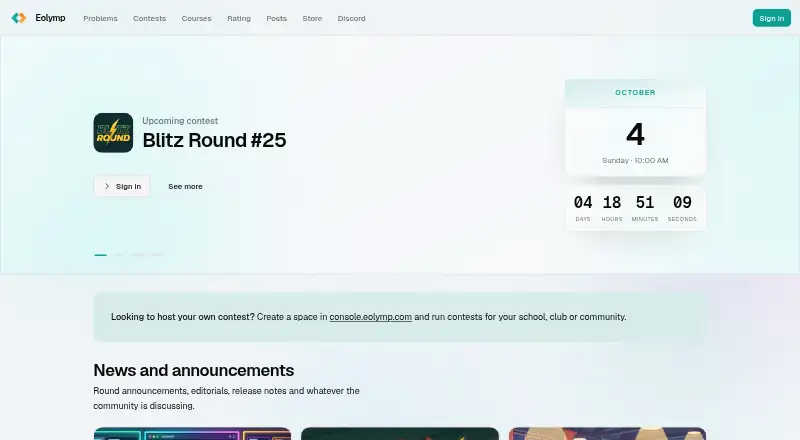
Eolymp is a platform for creating and hosting programming competitions and learning activities.
What Eolymp is
Eolymp is a platform for creating and hosting programming competitions and learning activities. Organizers can run synchronized online contests or virtual contests with participant-specific timers, then enable upsolving. Contest formats include IOI scoring with partial credit and ICPC scoring with time penalties. Problem-authoring tools cover statements, tests, checkers, solutions, validators, interactors and generators, and organizers can import problems from Basecamp or Polygon. Course tools combine modules, learning materials, assignments and grades. Eolymp says the hosted platform can handle official contests with thousands of participants as well as smaller practice rounds. The API uses HTTPS and JSON, supports API-key or OAuth 2.0 authentication, and has SDKs for Python, Go, PHP and JavaScript. Each space can connect to supported AI clients such as Claude and ChatGPT through an MCP server, with access governed by the signed-in user's permissions. Eolymp also describes Moodle and Canvas grading integration. New spaces can be evaluated free for 30 days with five seats and no payment details required to start.
Good
- Supports IOI and ICPC contest scoring formats.
- Virtual contests can use participant-specific timers.
- Problem tools include tests, checkers and validators.
- API SDKs are available for Python, Go, PHP and JavaScript.
- Free 30-day evaluation includes five seats.
Watch out
- The free evaluation lasts 30 days.
- The free evaluation space is limited to five seats.
- Paid plan prices are not shown.
Who it suits
Eolymp may suit educators and organizers who need to host programming contests, practice activities or courses. Its tools also serve learners preparing solutions and institutions using Moodle or Canvas grading integration.
Verdict
Eolymp brings contest hosting, problem authoring and course tools into one platform, with API and learning-system connections. The five-seat, 30-day evaluation can help assess fit, but paid plan prices are not shown.
Plans and prices
From Eolymp's own pricing page, checked 4 Oct 2026.
| Plan | Price | What it gives you |
|---|---|---|
| Free Services | Free | Free access to a database of programming problems and educational materials · access to programming competitions · automatic solution testing |
| Academic plan | Priced on request | For educational institutions and charitable organisations · quota can be adjusted to institutional needs · Discounted pricing is case-specific; page states 25% to 50% off regular price. |
| Custom | Priced on request | Custom quota for needs not met by published plans · Contact [email protected] for a custom configuration. |
| Paid plans | Priced on request | Plan-dependent quotas for contests, evaluations, courses, plagiarism analysis, upsolve, team contests, SSO, discussions, administrators, members and problems · Plans are priced per active user (seat); the pricing page does not show plan prices in its accessible text. |
The facts
Each one read from Eolymp's own pages, with the date it was checked.
What it does
- AI connectivity
- Each space has an MCP server that can connect supported AI clients such as Claude and ChatGPT, with access limited by the signed-in user's permissions.checked 4 Oct 2026
- Availability
- The SLA states a 99% monthly availability target, excluding scheduled and excused downtime, and covers the console, sign-in system, space websites and API.checked 4 Oct 2026
- Contest modes
- Organizers can run synchronized online contests or virtual contests with participant-specific timers, and may enable upsolving after the contest.checked 4 Oct 2026
- Contest scale
- The maker says the hosted platform supports official competitions with thousands of participants and practice rounds for smaller groups.checked 4 Oct 2026
- Courses
- Course tools combine modules, learning materials, assignments and grades for teaching.checked 4 Oct 2026
- Integrations
- The API uses HTTPS and JSON, supports API-key or OAuth 2.0 authentication, and provides SDKs for Python, Go, PHP and JavaScript.checked 4 Oct 2026
- LMS integration
- The maker says its grading system can be used with Moodle or Canvas, and that a space can connect to a student information system for login and account synchronization.checked 4 Oct 2026
- Problem authoring
- Organizers can create problems with statements, tests, checkers, solutions, validators, interactors and generators, and import problems from Basecamp or Polygon.checked 4 Oct 2026
- Purpose
- Eolymp provides a platform for creating and hosting programming competitions and learning activities.checked 4 Oct 2026
- Scoring formats
- Contests support IOI and ICPC scoring formats, with partial credit in IOI and time penalties in ICPC.checked 4 Oct 2026
- Security and privacy
- The privacy notice identifies EOLYMP ACADEMY, S.L. in Barcelona and says it processes data under GDPR and Spanish data-protection law; it does not plan international data transfers.checked 4 Oct 2026
- Support
- The help portal says users with further questions can contact Eolymp through its feedback page.checked 4 Oct 2026
The company
- Company history
- Eolymp says its website launched in 2007 to help people prepare for programming competitions.checked 4 Oct 2026
Money
- Trial limit
- A new space can be evaluated free for 30 days with five seats and the features of the selected plan, without payment details required to start.checked 4 Oct 2026
The full review of Eolymp
Eolymp is a contest-operations and programming-learning platform for educators, competition organizers and serious practice communities. It is best when one service must cover authoring, judging, courses and integrations; individual learners may find its administrative breadth unnecessary. The main decision is whether your seat-based plan and quotas match the scale of your program.
Overview
Eolymp combines programming practice, hosted contests and structured teaching spaces. Its hosted infrastructure is intended for both small practice rounds and official events with thousands of participants. Instructors can build courses from modules, materials, assignments and grades, while learners use the same environment for problem solving and automatic judging. The service traces its website to 2007, when it was created to help people prepare for programming competitions.
The free services are useful for trying the ecosystem or directing learners to an existing problem library, but organizations running their own recurring contests or courses will need to examine paid quotas carefully. Eolymp is a stronger fit for coordinated programs than for someone who only wants occasional coding exercises.
Key features
Contests and scoring
Organizers can select IOI scoring for partial credit or ICPC scoring with time penalties, so the platform supports both gradual-evaluation formats and classic ranked contests. Synchronized events put everyone on one schedule; virtual contests give each participant an individual timer. Optional upsolving keeps unfinished learning active after the official contest ends.
Authoring and judging
A problem can include its statement, tests, checker, solution, validator, interactor and generator. That is a substantial toolkit for teams producing original material rather than merely assembling public questions. Imports from Basecamp or Polygon can reduce migration work for existing problem collections. Supported submission languages include C++, Python, Java, Go, Pascal, Haskell, Lisp, Assembly, PHP, JavaScript and C#, with solution explanations and custom challenges also supported.
Courses and connections
Course modules, learning resources, assignments and grades make Eolymp viable for a class or training program, not just a contest calendar. Its HTTPS/JSON API accepts API-key or OAuth 2.0 authentication and has SDKs for Python, Go, PHP and JavaScript. Each space also exposes an MCP server for supported AI clients, including Claude and ChatGPT, while permissions remain tied to the signed-in user. The grading system can work with Moodle or Canvas, and a space can connect to a student-information system for login and account synchronization.
Pricing
Free Services
free. This tier provides access to the programming-problem and educational-material databases, participation in programming competitions and automatic solution testing. It suits learners and lightweight practice use; it does not describe the institution-level quotas and administration found in paid plans.
Academic plan
Custom pricing. Educational institutions and charitable organizations receive discounted pricing stated as 25% to 50% below the regular price, with quota adjustable to institutional needs. This is the logical starting point for schools or nonprofits whose enrollment and contest volume do not fit a standard allowance.
Paid plans
Custom pricing, billed per active user (seat). Quotas vary by plan for contests, evaluations, courses, plagiarism analysis, upsolve, team contests, SSO, discussions, administrators, members and problems. The seat model can align cost with an active cohort, but organizations must confirm both the required seats and every relevant quota before committing.
Custom
Custom pricing. Eolymp will configure quotas for requirements not met by published plans; contact [email protected]. A new space can be evaluated for 30 days with five seats and the selected plan's features, without payment details at signup. That trial is long enough to test a real course or contest workflow, but five seats limit evaluation of a larger team.
Platforms
Eolymp is delivered through the web and API. The API's standard HTTPS and JSON approach, authentication choices and language SDKs make it suitable for connecting existing tools rather than requiring every workflow to stay in the browser.
Who it's for
Choose Eolymp for universities, charitable education programs, contest organizers and training groups that need original problem engineering, judged events and coursework together. It is particularly suitable when Moodle, Canvas, a student-information system or an internal application must exchange grades or accounts. Solo learners who only want free challenge practice should use the free services or consider a simpler practice site.
Pros and cons
Pros
- One operational workspace: contest delivery, detailed problem components and course grading share the same environment.
- Flexible event formats: IOI, ICPC, synchronized, virtual and post-contest upsolve modes cover different teaching and competition goals.
- Integration depth: API authentication, SDKs, LMS support and student-account synchronization can fit institutional systems.
- Privacy and service commitments: GDPR and Spanish data-protection compliance are stated, with no planned international transfers and a 99% monthly availability target for core services.
Cons
- Cost requires a conversation: paid prices are not shown, and seat-based billing plus many separate quotas complicate budgeting.
- Trial scale is narrow: the 30-day evaluation is limited to five seats, so larger organizations cannot reproduce full deployment conditions.
- Administrative scope may be excessive: an individual looking only for puzzles gains little from course, integration and contest-management machinery.
Alternatives
For a broader comparison, see Coding Challenge Platforms.
- CodeSignal is the better pick for individual skills development and mobile access, with a free Individuals tier offering a tutor, skills paths and bite-sized practice.
- DMOJ suits organizations seeking free public contest hosting or a self-hosted/web option; private educational hosting carries a small fee.
- CSSBattle is preferable for free, browser-based CSS practice built around daily targets rather than general contest administration.
- Edabit is the simpler choice when all challenges must remain free and course or contest operations are unnecessary.
- HackerEarth Assessments fits hiring teams needing invite-based tests and interviews, including a free allowance of five test invites, three interview invites and two admins.
- AtCoder offers free contest participation and browser-based code execution for straightforward competitive programming.
- beecrowd is worth choosing for an academic individual account with one active subject, up to 20 students and more than 2,500 challenges at no cost.
- Codeforces is the direct free option for open contest participation without Eolymp's course and institutional tooling.
Verdict
Eolymp is a strong choice for institutions and organizers that need to author sophisticated problems, run varied contests and manage learning in one connected space. Its free services and five-seat trial lower the entry barrier, while API, LMS and account integrations support serious programs. Look elsewhere if transparent paid pricing, unlimited trial scale or a minimal practice-only experience matters more than an integrated administrative platform.
Alternatives to Eolymp
- 1

CodeSignal
Free planAndroidiOSWebAPI8.2From $24.99 a month - 2

HackerEarth Assessments
Free planAndroidiOSWebAPI8.2From $99 a month - 3
CodeChef IDE
Free planWebAPI7.4From $124 a year - 4

HackerRank
WebAPImacOSWindows7.4From $165 a month - 5

Codility
WebAPImacOSWindows7.3From $1,200 a year - 6
CSSBattle
Free planWeb6.7From $4.90 a month