DocBoy
DocBoy is an open-source emulator for the original Game Boy (DMG) and Game Boy Color (CGB), written in C++17.
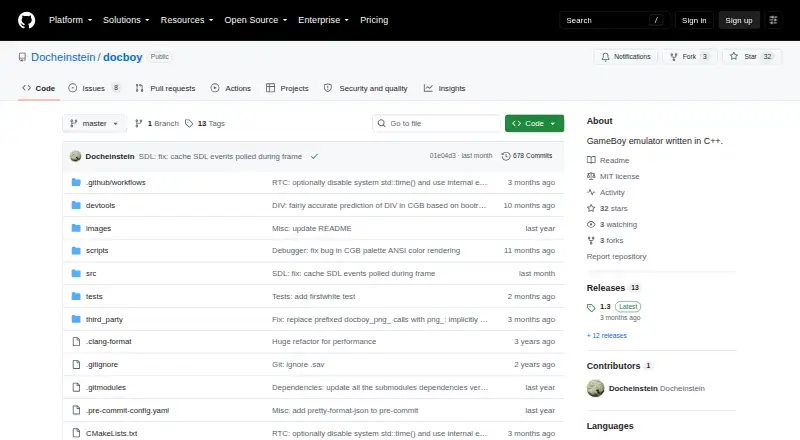
What DocBoy is
DocBoy is an open-source emulator for the original Game Boy (DMG) and Game Boy Color (CGB), written in C++17. It supports a range of cartridge types, including NoMBC, MBC1, MBC2, MBC3, MBC5, MBC7, HUC1, and HUC3, as well as audio, link cable emulation, and a real-time clock. Its CPU emulation is accurate to machine cycles, while its graphics emulation tracks clock cycles using a Pixel FIFO. Frontends include saving and loading, save states, fast-forward, configurable palettes, screenshots, and an SDL graphical menu. An optional command-line debugger offers disassembly, breakpoints, watchpoints, stepping, rewind, and memory viewing. DocBoy can also run as a libretro core with RetroArch. The project points to executable releases for Windows and Linux and documents building an Android libretro core; RetroArch supports Android and iOS. DocBoy is free and licensed under MIT. Its developers note that perfect emulation remains a long-term goal and that accuracy can affect performance.
Good
- Supports DMG and CGB systems and multiple cartridge types.
- Includes save states, fast-forward, and configurable palettes.
- Optional debugger includes breakpoints, rewind, and memory viewing.
- Can run as a libretro core with RetroArch.
Watch out
- Perfect emulation remains a distant goal.
- Accuracy may come at some performance cost.
- Executable releases are listed for Windows and Linux.
Who it suits
DocBoy suits players who want to emulate Game Boy or Game Boy Color games and use features such as save states, fast-forward, or configurable palettes. Developers and technically minded users may also value its optional debugger and libretro support.
Verdict
DocBoy combines Game Boy and Game Boy Color emulation with frontend conveniences and optional debugging tools. Its accuracy caveat is worth considering, and the listed executable releases are for Windows and Linux.
The facts
Each one read from DocBoy's own pages, with the date it was checked.
What it does
- Accuracy
- The emulator uses M-cycle accurate CPU emulation and T-cycle accurate PPU emulation with a Pixel FIFO.checked 7 Oct 2026
- Accuracy caveat
- The project says perfect emulation remains a distant goal and that accuracy may come at some performance cost.checked 7 Oct 2026
- Cartridges
- Supported cartridge types include NoMBC, MBC1, MBC2, MBC3, MBC5, MBC7, HUC1, and HUC3.checked 7 Oct 2026
- Contributions and support
- The README invites bug reports, failing test ROM reports, and feature proposals through issues or pull requests.checked 7 Oct 2026
- Debugger
- An optional GDB-style CLI debugger supports disassembly, breakpoints, watchpoints, stepping, rewind, and memory viewing.checked 7 Oct 2026
- Downloads
- The README points to releases with executables for Windows and Linux.checked 7 Oct 2026
- Downloads and builds
- The README says executable releases are available for Windows and Linux, and describes an Android libretro build option.checked 7 Oct 2026
- Emulation
- The README lists an M-cycle-accurate CPU, a T-cycle-accurate PPU, audio, and emulation for multiple cartridge types.checked 7 Oct 2026
- Frontend features
- Its frontends provide save/load, save states, fast-forward, configurable palettes, screenshots, and an SDL graphical menu.checked 7 Oct 2026
- Integration
- DocBoy can run as a libretro core with RetroArch.checked 7 Oct 2026
- License
- The repository identifies its license as MIT.checked 7 Oct 2026
- Limit
- The README says perfect emulation remains a distant goal and that accuracy may come at some cost to performance.checked 7 Oct 2026
- Mobile support
- The project documents building an Android libretro core, and says RetroArch supports platforms including Android and iOS.checked 7 Oct 2026
- Mobile use
- The README says the libretro core can be loaded through RetroArch, which it describes as supported on platforms including Android and iOS.checked 7 Oct 2026
- Other features
- The frontends include save/load, save states, fast-forward, configurable palettes, screenshots, and an SDL graphical menu.checked 7 Oct 2026
- Pricing
- The repository describes DocBoy as open source but does not state a price or offer a trial.checked 7 Oct 2026
- Product
- DocBoy is an open source GameBoy emulator written in C++17.checked 7 Oct 2026
- Support
- The project invites bug reports and feature proposals through issues and pull requests.checked 7 Oct 2026
- Systems emulated
- It supports the original DMG GameBoy and CGB GameBoy Color.checked 7 Oct 2026
The company
- Maker location
- The maintainer's GitHub profile lists Italy.checked 7 Oct 2026