Dataherald
Dataherald is an open-source natural language-to-SQL engine for asking questions about relational data in plain English through an API.
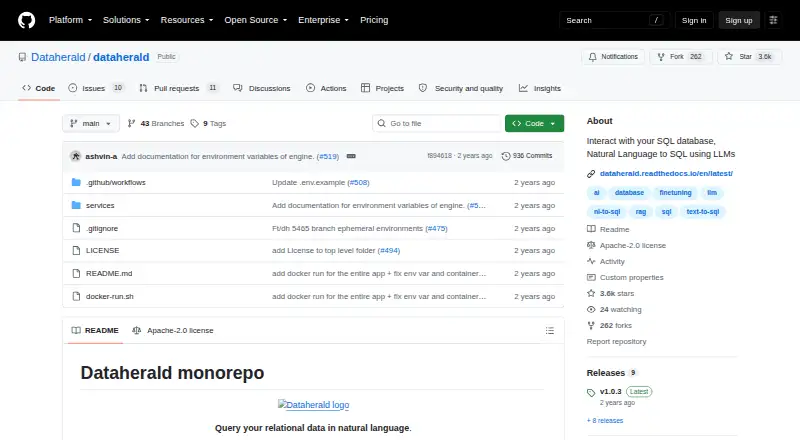
What Dataherald is
Dataherald is an open-source natural language-to-SQL engine for asking questions about relational data in plain English through an API. Its stated uses include letting business users query a warehouse, adding data Q&A to SaaS products, and creating a ChatGPT plug-in for proprietary data. The project is aimed at developers building natural-language interfaces for structured data or contributing to the engine. It can be self-hosted with Docker and Docker Compose, with MongoDB running separately for application data. Supported warehouse connections include PostgreSQL, BigQuery, Databricks, and Snowflake. The engine includes LangChain SQL Agent and SQL Chain, LlamaIndex SQL Generator, and Dataherald SQL Agent options. A context store can use table and column details, business context, and verified question-and-SQL examples to guide generation; an evaluator assigns generated SQL a confidence score. The modular implementation can be changed through .env configuration. Startup requires an OpenAI API key, organization ID, and encryption key. The quick start cautions that generated SQL may be inaccurate until business and data context are added.
Good
- Open-source Apache-2.0 license.
- Supports PostgreSQL, BigQuery, Databricks, and Snowflake.
- Context store accepts schema details and verified SQL examples.
- Generated SQL receives an evaluator confidence score.
- Database connection data is encrypted before Mongo storage.
Watch out
- Requires an OpenAI API key, organization ID, and encryption key.
- SQL may be inaccurate before context is added.
- Self-hosting setup includes Docker and separate MongoDB.
Who it suits
Dataherald suits developers building interfaces for structured-data questions, and teams seeking to let business users ask questions of warehouse data. It is also relevant to SaaS teams embedding data Q&A or developers exploring a proprietary-data ChatGPT plug-in.
Verdict
Dataherald offers several SQL-generation approaches and lets developers supply business and schema context. It requires configuration and self-hosting setup, and generated results may need context before they are accurate.
The facts
Each one read from Dataherald's own pages, with the date it was checked.
What it does
- Adaptability
- The documentation describes a modular architecture whose implementations can be replaced through configuration in the .env file.checked 4 Oct 2026
- API
- The engine exposes endpoints for database connections and natural-language questions, and the quick start points to a Swagger UI at /docs.checked 8 Oct 2026
- Components
- The repository describes an engine, an enterprise API layer with authentication and organizations, an admin console for configuration and observability, and a Slackbot.checked 4 Oct 2026
- Context
- The context store can use business and database context, including validated question-and-SQL examples and table information, to help generate SQL.checked 4 Oct 2026
- Context and learning
- Users can add database context by scanning tables and columns, providing verified SQL examples, and describing tables and columns; the documentation also describes active learning from usage.checked 8 Oct 2026
- Credentials
- The quick start requires an OpenAI API key, an organization ID, and an encryption key before starting the engine.checked 4 Oct 2026
- Database integrations
- The quick start says the engine supports PostgreSQL, BigQuery, Databricks, and Snowflake connections.checked 8 Oct 2026
- Database support
- The quick start lists PostgreSQL, BigQuery, Databricks, and Snowflake as currently supported warehouse connections.checked 4 Oct 2026
- Deployment
- The quick start describes self-hosting the engine with Docker, with Mongo running in a separate container for application data.checked 4 Oct 2026
- Deployment components
- The repository includes an engine, an enterprise API layer with authentication and organization and user support, an admin console for configuration and observability, and a Slack bot.checked 8 Oct 2026
- Evaluation
- The module overview says an evaluator assigns a confidence score to generated SQL.checked 4 Oct 2026
- Intended users
- The documentation is intended for developers building natural-language interfaces from structured data in their own projects and contributors to the engine.checked 8 Oct 2026
- License
- The GitHub repository identifies the project as licensed under Apache-2.0.checked 8 Oct 2026
- Notable accuracy consideration
- The quick start says generated SQL may be inaccurate until business logic and data context are added to the context store.checked 8 Oct 2026
- Product
- Dataherald is a natural language-to-SQL engine that exposes an API for asking questions about relational data in plain English.checked 4 Oct 2026
- Requirements
- The engine requires an OpenAI API key, an organization ID, and an encryption key in its environment configuration before startup.checked 8 Oct 2026
- Security
- The quick start says database connection data is encrypted before storage in MongoDB using an ENCRYPT_KEY and recommends changing the default MongoDB username and password.checked 8 Oct 2026
- Self-hosting
- The quick start describes running the engine locally with Docker and Docker Compose, alongside MongoDB for application data.checked 8 Oct 2026
- SQL generation
- Included text-to-SQL implementations are LangChain SQL Agent, LangChain SQL Chain, LlamaIndex SQL Generator, and Dataherald SQL Agent.checked 4 Oct 2026
- SQL generation options
- The documentation lists LangChain SQL Agent, LangChain SQL Chain, LlamaIndex SQL Generator, and Dataherald’s in-house SQL agent as included implementations.checked 8 Oct 2026
- Support and licensing
- The repository is public and identifies its license as Apache-2.0; the README invites contributions to the project.checked 4 Oct 2026
- Use cases
- The project describes use cases including helping business users explore a data warehouse, adding Q&A to SaaS applications, and creating a ChatGPT plug-in from proprietary data.checked 8 Oct 2026
- What it does
- Dataherald is a natural language-to-SQL engine that lets users ask questions in plain English about structured or relational data through an API.checked 8 Oct 2026
Alternatives to Dataherald
- 1

Outerbase AI
Free planOpen sourceWebAPILinuxmacOS8.2From $9 a month - 2
Insight O' Mate
Free planOpen sourceLinuxmacOSWindows7.8From $6.01 a month - 3

AskYourDatabase
AndroidiOSWebAPI7.3From $49 a month - 4

Wren AI
Free planWebAPISelf-hosted6.9From $179 a month - 5

ThoughtSpot
AndroidiOSWeb6.8From $25 a month - 6

BlazeSQL
WebAPImacOSWindows6.6From $150 a month