
Customs OS
Customs OS is a web service for licensed customs brokers and their operations teams.
What Customs OS is
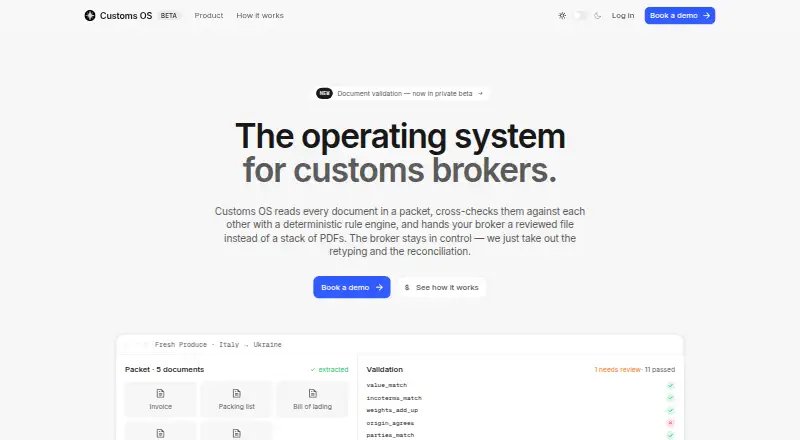
Customs OS is a web service for licensed customs brokers and their operations teams. It reads customs document packets, extracts fields, and checks information across documents using a deterministic rule engine; document validation is described as being in private beta. Users can upload scanned or digital commercial invoices, packing lists, bills of lading, certificates of origin, and arrival notices. Checks cover declared value, country of origin, incoterms, shipper, consignee, weights, and dates. Extracted values link to the source document and page, and pass or fail results link to named, versioned rules. Brokers can confirm or dismiss flagged exceptions, with decisions recorded against the packet. Customs OS does not file automatically: a licensed broker reviews outputs before acting. The privacy policy says packet content is sent to Google's Gemini models through the Vercel AI Gateway for extraction and validation, and is not used to train models. Pricing is available on request. HTS classification, ISF watcher, and CBP Form 7501 drafting are roadmap items, not current service features.
Good
- Accepts several types of customs documents.
- Checks values and details across documents.
- Extracted values link to source documents and pages.
- Records broker decisions on flagged exceptions.
- Outputs are reviewed by a licensed broker before action.
Watch out
- Document validation is in private beta.
- Does not file declarations automatically.
- HTS classification is a roadmap item, not a current feature.
- Pricing is available on request.
Who it suits
Customs OS is intended for licensed customs brokers and their operations teams handling document packets. It may suit brokers seeking traceable field extraction and cross-document checks while retaining human review before action.
Verdict
Customs OS focuses on extracting and checking packet information while keeping broker review central to the process. Its private-beta status, lack of automatic filing, and roadmap limits are important to consider.
The facts
Each one read from Customs OS's own pages, with the date it was checked.
What it does
- AI processing
- Uploaded packet content is sent to Google's Gemini models through Vercel AI Gateway for extraction, with the provider configured not to retain it for training.checked 9 Oct 2026
- Availability
- Document validation is in private beta.checked 9 Oct 2026
- Availability target
- The terms state a good-faith target of 99.5% monthly availability; a formal SLA applies only if included in a signed order form or MSA.checked 4 Oct 2026
- Breach notice
- Customs OS says it will notify the account's primary contact within 72 hours of becoming aware of a breach affecting personal data.checked 9 Oct 2026
- Compliance
- The company says it processes customer data under a DPA with EU Standard Contractual Clauses and supports GDPR, UK GDPR, and Swiss FADP requirements.checked 9 Oct 2026
- Document intake
- Users can upload commercial invoices, packing lists, bills of lading, certificates of origin, and arrival notices in scanned or digital layouts.checked 9 Oct 2026
- Evidence and review
- Extracted values trace to their source document and page, and brokers can confirm or dismiss flagged exceptions, with their decisions recorded against the packet.checked 4 Oct 2026
- Evidence trail
- Extracted values can be traced to their source document and page, and pass or fail results link to named, versioned rules.checked 9 Oct 2026
- Filing limit
- Customs OS says it does not file automatically and that a licensed broker reviews outputs before acting.checked 9 Oct 2026
- Human oversight
- Customs OS says it does not file automatically; its outputs are for a licensed broker to review before acting.checked 4 Oct 2026
- Human review
- Brokers review exceptions and confirm or dismiss flags; the decision is recorded against the packet.checked 9 Oct 2026
- Integrations
- The site asks whether Customs OS integrates with DMS, AGS, or Portbase but does not provide an answer on the opened page.checked 9 Oct 2026
- Intended customers
- The terms say Customs OS is sold to licensed customs brokers and their operations teams.checked 4 Oct 2026
- Purpose
- Customs OS reads document packets and cross-checks them with a deterministic rule engine to give brokers a reviewed file.checked 9 Oct 2026
- Roadmap limits
- The terms say HTS classification, ISF watcher, and CBP Form 7501 drafting are roadmap items and are not part of the service until explicitly announced.checked 4 Oct 2026
- Security
- Customs OS states that it uses TLS 1.2+ in transit, AES-256 at rest, tenant isolation, and least-privilege internal access.checked 9 Oct 2026
- Support
- The site lists [email protected] for support inquiries and offers a 30-minute product demo.checked 9 Oct 2026
- Validation
- The rule engine checks declared value, country of origin, incoterms, shipper, consignee, weights, and dates across documents.checked 9 Oct 2026
The company
- Company
- The legal pages identify the maker as Customs OS, Inc.; the opened pages do not state its headquarters or founding year.checked 4 Oct 2026
- Maker
- The maker identifies itself as Customs OS, Inc. and describes its software as built for licensed customs brokers.checked 9 Oct 2026
The full review of Customs OS
Customs OS is a web application for licensed customs brokers and their operations teams who need a document packet checked before anyone files. It is a strong fit for organisations that need source-level evidence and recorded exception decisions. Its value is as a broker-controlled validation layer, not as an automated filing or classification system.
Overview
Users can upload or drag in commercial invoices, packing lists, bills of lading, certificates of origin and arrival notices, whether scanned or digitally produced. A deterministic rule engine compares declared value, country of origin, incoterms, shipper, consignee, weights and dates across the packet.
Every extracted value can be traced to its source document and page, while pass or fail results link to named, versioned rules. Brokers can confirm or dismiss flagged exceptions, and that decision is recorded against the packet. This creates a practical audit trail for resolving discrepancies. Document validation is in private beta, however, so teams should treat the product as a developing review aid rather than a fully established compliance platform.
Key features
Evidence-linked extraction
Page-level references let a reviewer inspect the underlying evidence instead of accepting an unexplained field value. Versioned rule links show which logic produced a result, supporting repeatable investigations and consistent packet records.
Cross-document validation
The checks target common consistency points across shipping paperwork. That can expose mismatched values or dates before a broker acts, but it does not provide tariff classification or prepare a customs declaration.
Human-controlled exception handling
Customs OS does not file automatically. A licensed broker remains responsible for reviewing outputs and deciding what to do, with confirmations and dismissals retained against the packet. This suits firms that require professional sign-off; it will not suit buyers seeking unattended submission.
Data handling and controls
Packet content is sent to Google's Gemini models through the Vercel AI Gateway for extraction and validation and is not used to train models. The stated controls include TLS 1.2 or later in transit, AES-256 at rest, tenant isolation and least-privilege internal access. Customs OS describes processing under GDPR, UK GDPR and Swiss FADP terms with a DPA and EU Standard Contractual Clauses; SOC 2 is in progress. Breach notices go to the account's primary contact within 72 hours of awareness when personal data is affected.
Pricing
Customs OS uses paid, custom pricing: the site asks prospective customers to request pricing. That is appropriate for broker operations that need a scoped commercial discussion, but it gives smaller teams no predictable self-serve entry point. There are no published seat quotas, document allowances, trial terms or renewal conditions to compare.
Support is offered through [email protected], and the company offers a 30-minute demonstration using a customer's real packets. The terms set a good-faith target of 99.5% monthly availability; a formal SLA applies only when included in a signed order form or MSA.
Platforms
Customs OS runs on the web, making it suitable for teams working from browser-based operations environments. The homepage raises possible DMS, AGS and Portbase integrations but does not confirm that any integration is available.
Who it's for
The product is expressly sold to licensed customs brokers and their operations teams. It is a sensible choice when packet-level evidence, deterministic checks and a retained broker decision matter more than automatic filing. Importers looking for a standalone declaration service, or teams that require HS classification, should look elsewhere: classification, ISF watching and CBP Form 7501 drafting are roadmap items rather than current service components.
Pros and cons
- Pro: Source-document and page references make extracted values and exceptions inspectable.
- Pro: Named, versioned rules and recorded broker decisions create a durable review trail.
- Pro: Encryption, tenant isolation and stated GDPR-family contractual measures address core data-governance needs.
- Con: Private-beta validation introduces product-maturity risk for production-critical workflows.
- Con: No automatic filing, declaration preparation or HS classification means brokers still need separate capabilities.
- Con: Custom pricing and unconfirmed integrations make procurement and system planning harder.
Alternatives
Choose Customs Declarations UK when you need API and web access with a free-per-processed-document IDP option and declaration-oriented plans.
CustomsLink is the better starting point for a free registration and a toolkit covering ENS, EXS and port-pass transactions.
Pick CustomsVerse if a no-credit-card product-classification option, including bulk classification, is the priority.
Customs Window suits organisations wanting Android, iOS, API and web coverage with tailored monthly pricing and unlimited users.
Consider Candata ACE/ABI for macOS or Windows desktop deployment and a demo-led purchase.
iCustoms is an alternative paid API and web service that offers a free trial.
MIC-CUST is another paid web option.
Choose SmartBorder ABI/ACE if a pay-per-use model, no long-term contract and no user licensing fees are more important than Customs OS's packet-review focus.
Verdict
Customs OS is recommended for licensed broker teams that want traceable extraction, deterministic cross-document checks and documented human decisions before filing. Its main reason to choose it is the evidence trail from field to source page and rule. Look elsewhere if you need HS classification, declaration filing, confirmed system integrations or a mature production service rather than a private-beta validation layer.
Alternatives to Customs OS
- 1
Customs Declarations UK
Free planWebAPI6.7£4 one-time - 2

Customs Window
AndroidiOSWebAPI6.6 - 3

CustomsLink
Free planWebAPI6.6£100 one-time - 46.6From €66 a month
- 5
XEMI
Web6.3 - 6
DutyDeclared
WebAPI6.2From £250 a month