Comunica
Comunica is an open-source framework for querying knowledge graphs with SPARQL and GraphQL over decentralized RDF on the Web.
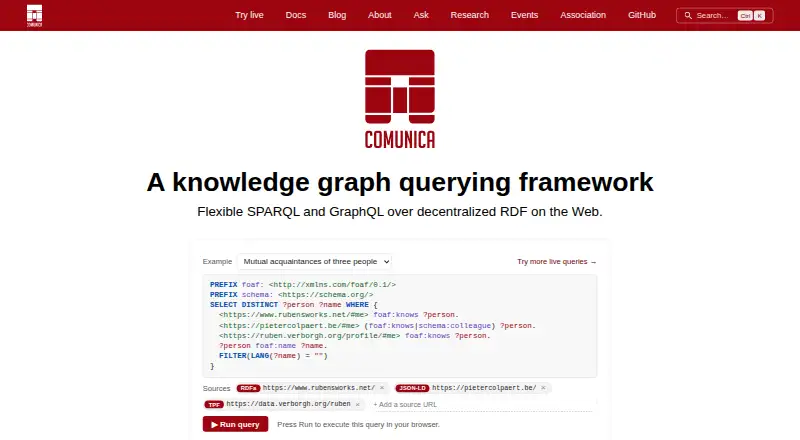
What Comunica is
Comunica is an open-source framework for querying knowledge graphs with SPARQL and GraphQL over decentralized RDF on the Web. It can combine different kinds of sources into one virtual dataset and identify a source type from its URL. Built-in source types include RDF files, SPARQL endpoints, Triple Pattern Fragments, JavaScript RDF sources, serialized datasets, and HDT files. Comunica supports several SPARQL 1.2 specifications and parses formats including Turtle, JSON-LD, RDF/XML, N-Triples, TriG, and N-Quads. Results can be serialized as SPARQL JSON, XML, CSV, TSV, or RDF formats. Its browser client offers SPARQL and GraphQL-LD queries, Solid authentication, selectable data sources, and geospatial results. Developers can assemble engines from modules or extend them with components, and use the framework in browsers, JavaScript applications, or from the command line. It is available under the MIT license for open and commercial projects. The default SPARQL engine does not query local files; a separate file engine is intended for that purpose. SPARQL 1.2 entailment regimes and the Graph Store HTTP Protocol are listed as unsupported.
Good
- Combines varied sources into one virtual dataset.
- Supports SPARQL and GraphQL queries.
- Runs in browsers, JavaScript applications, and command line.
- MIT license permits open and commercial use.
Watch out
- Default SPARQL engine does not query local files.
- SPARQL 1.2 entailment regimes are unsupported.
- Graph Store HTTP Protocol is unsupported.
Who it suits
Comunica is intended for researchers and developers working with query execution and decentralized RDF knowledge graphs. Its configurable engines and browser client offer distinct ways to work with data sources.
Verdict
Comunica offers flexible querying across decentralized RDF sources and configurable runtime options. Users needing local-file queries must use its separate file engine, and two listed specifications are unsupported.
Plans and prices
From Comunica's own pricing page, checked 30 Sep 2026.
| Plan | Price | What it gives you |
|---|---|---|
| Comunica | Free | Open-source framework · MIT license |
The facts
Each one read from Comunica's own pages, with the date it was checked.
What it does
- AI integration
- Comunica engines can be exposed through MCP so AI agents can query decentralized RDF knowledge graphs.checked 30 Sep 2026
- Customization
- Users can configure their own query engine by combining modules or extend Comunica with new components.checked 30 Sep 2026
- Federated queries
- It can query multiple different sources together as one virtual dataset.checked 30 Sep 2026
- Intended users
- Comunica describes itself as a flexible research platform for query execution and says it aims to educate researchers and developers.checked 29 Sep 2026
- Known limits
- SPARQL 1.2 entailment regimes and the Graph Store HTTP Protocol are listed as unsupported.checked 30 Sep 2026
- License
- Comunica is open-source software under the MIT license, which the project says permits use in open and commercial projects.checked 30 Sep 2026
- Limits
- The specifications page lists SPARQL 1.2 Entailment Regimes and Graph Store HTTP Protocol as not yet supported.checked 29 Sep 2026
- Local files
- The default Comunica SPARQL engine does not allow querying local files for security reasons; the separate Comunica SPARQL File engine is intended for that use.checked 30 Sep 2026
- Open source
- Comunica is available under the MIT license for use in open and commercial projects.checked 29 Sep 2026
- Organization
- The Comunica Association is a nonprofit organization that supports the framework’s roadmap, maintenance, and development.checked 30 Sep 2026
- Product
- Comunica is an open-source knowledge graph querying framework for flexible SPARQL and GraphQL over decentralized RDF on the Web.checked 29 Sep 2026
- Purpose
- Comunica is a knowledge graph querying framework for flexible SPARQL and GraphQL queries over decentralized RDF on the Web.checked 30 Sep 2026
- Query federation
- It can query multiple sources of different types as one virtual dataset.checked 29 Sep 2026
- Query results
- Results can be serialized in SPARQL JSON, XML, CSV, TSV, and several RDF formats.checked 29 Sep 2026
- Query standards
- The project lists SPARQL 1.2 query, update, federated query, service description, result formats, and protocol among supported specifications.checked 30 Sep 2026
- RDF formats
- Supported RDF input formats include Turtle, TriG, JSON-LD, RDFa, RDF/XML, N-Triples, N-Quads, Notation3, and Microdata.checked 30 Sep 2026
- Runtime options
- Comunica can be used in browsers, JavaScript applications, and from the command line.checked 30 Sep 2026
- Security and compliance
- The pages reviewed describe supported standards and features but do not state a security certification or compliance program.checked 29 Sep 2026
- Solid support
- Comunica supports querying public and authenticated Solid pod documents, and offers experimental link traversal across pods.checked 30 Sep 2026
- Source detection
- Given a source URL, Comunica automatically detects its type and handles it accordingly.checked 29 Sep 2026
- Source types
- Built-in source types include RDF files, SPARQL endpoints, Triple Pattern Fragments, JavaScript RDF sources, serialized datasets, and HDT files.checked 30 Sep 2026
Where it runs
- Browser client
- The live Web client offers SPARQL and GraphQL-LD queries, Solid authentication, selectable data sources, and geospatial results.checked 29 Sep 2026
- Platforms
- Documentation describes use in browsers, Node.js applications, the command line, Docker containers, and as a SPARQL protocol endpoint.checked 29 Sep 2026
The company
- Headquarters
- Ghent, Belgiumchecked 28 Sep 2026
The full review of Comunica
Overview
Comunica is a modular framework for querying decentralized RDF data with SPARQL and GraphQL. It is best suited to researchers and developers building knowledge-graph applications that need to combine varied sources; it is a poor fit for SQL workloads or for querying local files through the default engine.
Its strongest case is flexible federation across different RDF sources, with browser, JavaScript, and command-line use. The trade-off is that users must choose the right engine for local files, and two listed specifications remain unsupported.
Key features
Federated querying
Comunica can treat multiple source types as one virtual dataset, including SPARQL endpoints, Triple Pattern Fragments, RDF files, JavaScript RDF sources, serialized datasets, and HDT files. It detects a source type from its URL, reducing the setup burden when working across heterogeneous data. This is useful when a query must span distributed graph data, but it does not make Comunica a general-purpose SQL engine.
Standards and formats
Supported specifications include SPARQL 1.2 Query, Update, Service Description, Federated Query, and Protocol. It parses Turtle, JSON-LD, RDF/XML, N-Triples, TriG, and N-Quads, and can serialize results as SPARQL JSON, XML, CSV, TSV, and several RDF formats. SPARQL 1.2 Entailment Regimes and the Graph Store HTTP Protocol are unsupported, so teams depending on either should choose another approach.
Browser, Solid, and extensions
The live web client supports SPARQL and GraphQL-LD, Solid authentication, selectable data sources, and geospatial results. Comunica can query public and authenticated Solid pod documents, with experimental link traversal across pods. Users can assemble a query engine from modules and add components, a useful degree of control for custom research and application needs, though it assumes users are prepared to configure and extend a framework.
Engines can also be exposed through MCP for AI agents querying decentralized RDF graphs. The default SPARQL engine blocks local-file queries for security reasons; users who need that capability must use the separate Comunica SPARQL File engine.
Pricing
Comunica is free: its sole Comunica plan costs nothing and provides the open-source framework under the MIT license. There is no paid tier or free trial. The license permits use in open and commercial projects, so the cost is not tied to a seat count or usage quota. The framework is self-hosted, which makes it a better match for teams able to manage their own deployment than for buyers seeking a managed service.
Project questions go to the Gitter community or GitHub discussions, bugs to the GitHub issue tracker, and commercial support inquiries to an email contact. The project describes no security certification or compliance program.
Platforms
Comunica supports API, Linux, macOS, self-hosted, web, and Windows use. It runs in browsers, JavaScript applications, and from the command line, giving developers several ways to integrate it. Its default engine's local-file restriction means platform availability should not be confused with unrestricted access to files on the host.
Who it's for
Comunica suits researchers and developers working with decentralized RDF, especially those who need to query across mixed source types or customize query execution. Its stated focus as a research platform and educational resource aligns with experimentation and application development. It is not the right choice for teams looking for SQL support, or for users who want the default engine to query local files.
Pros and cons
- Pro: Federation across multiple source types lets users query distributed RDF as one virtual dataset.
- Pro: Broad RDF parsing and result serialization support accommodates varied graph-data workflows.
- Pro: MIT licensing allows both open and commercial use at no charge.
- Con: Local-file querying requires a separate engine, adding a choice and setup step for that workflow.
- Con: Entailment Regimes and Graph Store HTTP Protocol are unsupported, which rules it out for requirements centered on those specifications.
- Con: No SQL support limits its usefulness outside RDF and knowledge-graph querying.
Alternatives
Apache Drill is another free, downloadable option for embedded or cluster deployment; choose it when that deployment model better fits your query-engine needs.
Denodo Platform is worth considering when a developer plan's capacity limits fit: its free Developer plan includes one server, 4 cores, 50 data products, 2.5 TB per year, and unlimited data sources, consumers, and Data Marketplace users; a free trial is also available.
Starburst Galaxy offers a free-forever plan with up to three clusters and standard execution for ad hoc queries, plus a Pro plan starting at $0.5 per contact; consider it when those plan terms suit the workload better than a self-hosted RDF framework.
Apache Arrow DataFusion is a free Rust library and CLI distributed as source artifacts, a relevant alternative for users seeking that form of query-engine project.
Apache Impala is free Apache-licensed software with source and binary releases, another option for buyers comparing open-source query engines.
PrestoDB is a free, self-hosted open-source SQL query engine; choose it when SQL rather than decentralized RDF is the priority.
Databricks Notebooks offers a web-based Free Edition with one serverless workspace and limited compute size and usage, which may suit users who want a hosted notebook environment with those constraints.
Firebolt provides a free, self-hosted Core plan with no usage limits, but it cannot be used to build a hosted SaaS that competes with Firebolt's managed service.
Verdict
Choose Comunica if you are a researcher or developer who needs free, customizable SPARQL or GraphQL querying across decentralized RDF sources. Its federation and range of supported data formats are the main reasons to choose it. Look elsewhere if you need SQL, built-in local-file queries from the default engine, or either of its unsupported specifications.
Getting started
- Visit https://comunica.dev/.
- Use the browser client for SPARQL or GraphQL-LD queries.
- Run Comunica in a browser, JavaScript application, or from the command line.
- Combine modules to configure a query engine, or extend it with new components.
- For local-file queries, use the separate Comunica SPARQL File engine.
Limits worth knowing
The default SPARQL engine does not allow local-file queries; the separate Comunica SPARQL File engine is intended for that use. SPARQL 1.2 Entailment Regimes and the Graph Store HTTP Protocol are listed as unsupported.
Questions
How much does Comunica cost?
Comunica is free and open source under the MIT license.
Can it query multiple source types together?
Yes. It can query multiple sources as one virtual dataset, including RDF files, SPARQL endpoints, Triple Pattern Fragments, JavaScript RDF sources, serialized datasets, and HDT files.
Which platforms and runtimes are supported?
The listed platforms include API, Linux, macOS, self-hosted, web, and Windows. It can run in browsers, JavaScript applications, and from the command line.
Can the default engine query local files?
No. The default SPARQL engine does not allow local-file queries; a separate SPARQL File engine is intended for that use.
Is Comunica open source?
Yes. It is available under the MIT license, which permits open and commercial projects.
Where is the project based, and how can users get support?
Comunica is listed as headquartered in Ghent, Belgium. The project directs questions to its Gitter community and GitHub discussions, bugs to its GitHub issue tracker, and commercial support inquiries to an email contact.
Alternatives to Comunica
- 1
PrestoDB
Free planOpen sourceWebAPILinuxmacOS7.7Free plan - 2

Starburst Enterprise Context Layer
Free planWebAPISelf-hosted7.5$0.50 usage-based - 3

Apache Hive
Free planOpen sourceAPILinuxmacOSSelf-hosted7.4Free plan - 4

IBM Db2
Free planWebAPILinuxSelf-hosted7.4From $630 a month - 5

Starburst Galaxy
Free planWebAPILinux7.1Free plan - 6
Apache Drill
Free planAPILinuxmacOSSelf-hosted6.7Free plan