
CloudCasa
CloudCasa is a data protection and recovery service for Kubernetes, cloud databases, cloud-native applications, and Kubernetes-native virtualization.
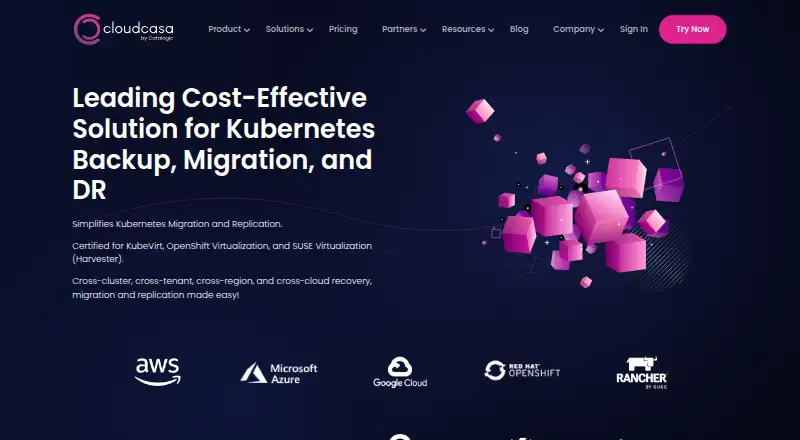
What CloudCasa is
CloudCasa is a data protection and recovery service for Kubernetes, cloud databases, cloud-native applications, and Kubernetes-native virtualization. It backs up Kubernetes persistent data and resources, including cluster and cloud configurations, and supports restoring or migrating them across clusters, accounts, regions, and clouds. It also backs up and restores KubeVirt virtual machines, including individual files. CloudCasa connects natively with AWS EKS and RDS, Microsoft Azure AKS, and Google Cloud GKE. Teams can use it as managed SaaS or deploy it themselves in on-premises, cloud, or edge environments. A central console controls configuration, schedules, retention policies, storage destinations, and jobs. Backup data is encrypted in transit with TLS and at rest with AES-256, with stored objects isolated between users; role-based access is customizable. The free plan supports up to five nodes, 30-day retention, and three users per organization. CloudCasa Pro is $69/node/month billed annually, with a 60-day trial; Enterprise pricing is custom.
Good
- Backs up Kubernetes data, resources, and configurations.
- Restores and migrates across clusters, accounts, regions, and clouds.
- Supports KubeVirt virtual machines and file-level restore.
- Integrates with AWS, Azure, and Google Cloud services.
- Encrypts backups in transit and at rest.
Watch out
- Free plan is limited to five nodes.
- Free retention is limited to 30 days.
- Pro costs $69/node/month with annual billing.
- Enterprise pricing is custom and not listed.
Who it suits
CloudCasa suits developers, DevOps, platform engineering, and IT operations teams managing Kubernetes and related workloads. Organizations can choose managed SaaS or self-hosted deployment.
Verdict
CloudCasa combines Kubernetes backup, recovery, and migration with support for KubeVirt virtual machines and major cloud services. Its deployment choices and centralized controls may suit teams with varied infrastructure, while the free plan has node, retention, and user limits.
Plans and prices
From CloudCasa's own pricing page, checked 21 Oct 2026.
| Plan | Price | What it gives you |
|---|---|---|
| CloudCasa Free Trial | Free | up to 5 nodes · daily schedules · 30-day retention · maximum 3 users · community support |
| CloudCasa Pro | $69 a month | per node/month · advanced policies · application-aware backups · cross-cluster and file-level restore · migration and replication · RBAC · API and CLI automation · 24x7 support · Annual Subscription |
| CloudCasa Enterprise | Priced on request | self-hosted or air-gapped · advanced policies · application-aware backups · cross-cluster and file-level restore · migration and replication · RBAC · API and CLI automation · 24x7 support |
The facts
Each one read from CloudCasa's own pages, with the date it was checked.
What it does
- Access control
- CloudCasa provides customizable role-based access control.checked 1 Oct 2026
- Additional ecosystem
- The maker lists integrations or collaboration with Microsoft, Red Hat, SUSE, VMware, Akamai, DigitalOcean, Google Cloud and Oracle Cloud.checked 21 Oct 2026
- API
- The REST API uses https://api.cloudcasa.io/api/v1 for SaaS and an installation-specific /api/v1 endpoint for self-hosted deployments.checked 21 Oct 2026
- API authentication
- API requests use bearer API tokens; SaaS token access is limited to paid accounts while self-hosted access is enabled.checked 21 Oct 2026
- API tooling
- Self-hosted administrators can obtain an OpenAPI specification and explore endpoints with Swagger UI.checked 21 Oct 2026
- Backup scope
- It backs up whole clusters, namespaces, applications, Kubernetes resources, persistent volumes and cloud configurations.checked 21 Oct 2026
- Central management
- CloudCasa centrally controls configuration, scheduling, retention policies, storage destinations, and job scheduling.checked 1 Oct 2026
- Cloud integrations
- Native cloud-account integrations include AWS EKS and RDS, Azure AKS and Google GKE.checked 21 Oct 2026
- Cross-environment recovery
- Restores and migrations can target other clusters, accounts, regions and clouds.checked 21 Oct 2026
- Deployment
- CloudCasa is available as a fully managed SaaS service or as a self-hosted deployment for on-premises, cloud, or edge environments.checked 1 Oct 2026
- Deployment models
- The product is offered as managed SaaS or self-hosted on-premises, in private clouds and at edge locations.checked 21 Oct 2026
- Documentation
- Documentation is divided into a User Guide, Self-hosted Admin Guide and API Guide with examples.checked 21 Oct 2026
- Extensibility
- The self-hosted installation exposes an optional MCP server for connecting AI assistants.checked 21 Oct 2026
- Immutable backups
- Immutable backup storage is supported through user object-storage immutability and SafeLock capabilities.checked 21 Oct 2026
- Licence
- An independent review describes CloudCasa as closed-source software governed by a single vendor.checked 21 Oct 2026
- Limit: data classification
- A G2 reviewer says data classification is not granular enough to exclude items such as application logs from backups.checked 21 Oct 2026
- Limit: workload coverage
- G2 reviewers report weaker support for non-Kubernetes applications and dependence on a third-party provider.checked 21 Oct 2026
Where it runs
- Application protection
- Application-consistent backups cover databases and application components, with recovery down to individual persistent-volume files.checked 21 Oct 2026
The company
- Company founding and headquarters
- LinkedIn lists CloudCasa as founded in 2020 and headquartered in Paramus, New Jersey.checked 21 Oct 2026
- Company size
- LinkedIn lists CloudCasa as a privately held company with 11–50 employees.checked 21 Oct 2026
- Founded
- 1996checked 23 Sep 2026
- Headquarters
- Paramus, New Jersey, United Stateschecked 23 Sep 2026
Money
- Free limits
- The free plan supports up to five nodes, 30-day retention, multiple clusters from one dashboard, and a maximum of three users per organization.checked 1 Oct 2026
- Limit: free tier
- The free offering limits retention to 30 days, supports up to five worker nodes and allows up to three users per organization on the current pricing page.checked 21 Oct 2026
Alternatives to CloudCasa
- 1
Bacula Enterprise
AndroidWebAPILinux7.9From $90 a year - 2

Plakar
Free planOpen sourceWebAPILinuxmacOS7.8Free plan - 3

Storware Backup & Recovery
Free planWebAPILinuxmacOS7.5Free plan - 4
Vinchin Backup & Recovery
Free planWebLinuxSelf-hostedWindows7.3Free plan - 5

Veeam Kasten for Kubernetes
Free planWebAPILinuxSelf-hosted7.1Free plan - 6

Afi Kubernetes Backup
Free planWebAPISelf-hosted6.7From $140 a month