
Cloud Native Buildpacks Lifecycle
Cloud Native Buildpacks Lifecycle is a free, open-source component that turns application source code into OCI container images.
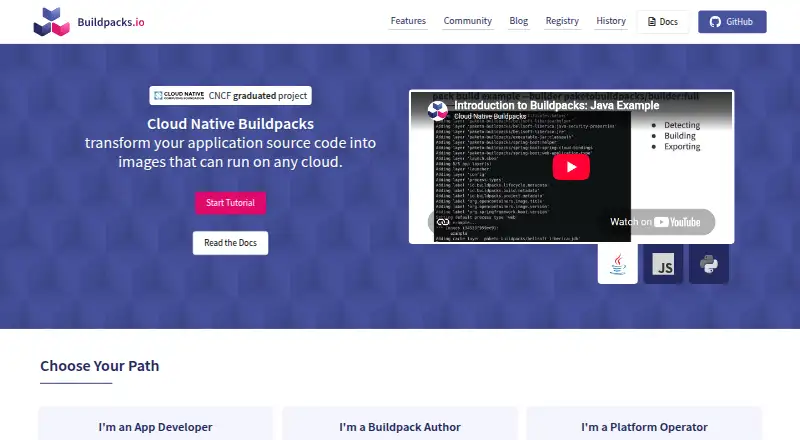
What Cloud Native Buildpacks Lifecycle is
Cloud Native Buildpacks Lifecycle is a free, open-source component that turns application source code into OCI container images. It coordinates buildpacks, allowing developers to build without writing a Dockerfile, and can run images on any cloud. The lifecycle moves through analyze, detect, restore, build, and export phases, then supports rebasing application layers onto a new runtime base image. Detection and build run as non-root users; credential-dependent phases use separate containers. It must run inside a containerized environment such as Docker or CI/CD, while analyzer, restorer, and exporter need an OCI registry or Docker-compatible daemon. Features include auto-detection, caching, modular and multi-language buildpacks, multiple process entrypoints, reproducible builds, multi-architecture output, and multiple cache backends. Build-time SBOMs can use CycloneDX, SPDX, or Syft JSON. The project uses Apache-2.0 and lists Pack, Tekton, kpack, CircleCI, and GitLab Auto DevOps integrations.
Good
- Builds applications without Dockerfiles
- Five-phase image lifecycle
- Supports image rebasing without app rebuilds
- Non-root detection and build execution
- Multi-architecture and SBOM support
Watch out
- Must run in a containerized environment
- Registry or daemon access is required
- Credentials must be available in phase containers
Who it suits
It suits developers and buildpack authors who want Dockerfile-free application builds and custom language or framework support. Teams using containerized CI/CD or cloud platforms can use its lifecycle model.
Verdict
Cloud Native Buildpacks Lifecycle provides a structured, open-source route from source code to OCI images. Its container, registry, and credential requirements should be planned alongside the chosen integration.
The facts
Each one read from Cloud Native Buildpacks Lifecycle's own pages, with the date it was checked.
Where it runs
- App developers
- Buildpacks let app developers build apps without writing a Dockerfile.checked 10 Oct 2026
- Platform examples
- The project describes Pack as a local CLI, Tekton as a CI plugin, and kpack as a cloud app platform that can run buildpacks.checked 9 Oct 2026
What it does
- Buildpack authors
- Authors can create custom buildpacks to support a language, framework, or toolchain.checked 10 Oct 2026
- Build phases
- An image build uses five phases: analyze, detect, restore, build, and export.checked 9 Oct 2026
- Distribution
- The lifecycle can be installed by extracting its release archive and copying the binaries into a build image; an OCI lifecycle image is also provided.checked 9 Oct 2026
- Dockerfile alternative
- The project says app developers can use buildpacks to build apps without writing a Dockerfile.checked 9 Oct 2026
- Execution requirement
- The lifecycle must run in a containerized environment, such as a Docker container or CI/CD system.checked 10 Oct 2026
- Features
- Features include auto-detection, advanced caching, modular buildpacks, multi-language support, multiple process entrypoints, image rebasing, and reproducible builds.checked 10 Oct 2026
- Governance
- Cloud Native Buildpacks is a graduated Cloud Native Computing Foundation project.checked 10 Oct 2026
- Image maintenance
- The lifecycle includes rebase, which places application layers atop a new runtime base image.checked 9 Oct 2026
- Image repository access
- The analyzer, restorer, and exporter require access to an OCI registry or Docker-compatible daemon; registry credentials or a Docker socket must be available in the container where the phase runs.checked 9 Oct 2026
- Image updates
- Rebasing updates base images without rebuilding the application image.checked 10 Oct 2026
- Integrations
- The documentation describes integrations with CircleCI, GitLab Auto DevOps, kpack, Pack, and Tekton.checked 10 Oct 2026
- License
- The lifecycle repository identifies its license as Apache-2.0.checked 9 Oct 2026
- Lifecycle
- The lifecycle orchestrates buildpacks and assembles their output into an OCI image through distinct phases.checked 10 Oct 2026
- Lifecycle role
- The lifecycle orchestrates buildpacks and assembles their artifacts into an OCI image.checked 9 Oct 2026
- Purpose
- Cloud Native Buildpacks transform application source code into OCI container images that can run on any cloud.checked 10 Oct 2026
- Runtime requirement
- The lifecycle must run in a containerized environment, such as a Docker container or CI/CD system.checked 9 Oct 2026
- SBOM
- Build-time software bills of materials are supported in CycloneDX, SPDX, and Syft JSON formats.checked 10 Oct 2026
- Security
- For security hardening, registry-access phases run in separate containers, while the lifecycle and buildpacks run as non-root users during detection and build.checked 10 Oct 2026
- Support
- The project directs users to CNCF Slack or its mailing list to contact the team.checked 10 Oct 2026
- Support and community
- The project links to a mailing list, Slack, GitHub, and issue reporting for community support and feedback.checked 9 Oct 2026
The company
- Founded
- 2018checked 28 Sep 2026
Alternatives to Cloud Native Buildpacks Lifecycle
- 1
Avidemux
Free planOpen sourceWebLinuxmacOSWindows7.3Free plan - 2

Understand
APIExtensionLinuxmacOS7.2From $100 a month - 3

ast-grep
Free planWebAPIExtensionLinux7.0Free plan - 4

Chromium
Open sourceAndroidiOSExtensionLinux6.9 - 5
Semantic Designs Source Code Search Engine
Free planAPILinuxSelf-hostedWindows6.7Free plan - 6

Code Fundi
Free planWebAPIExtension6.6From $21 a month