
Campfire
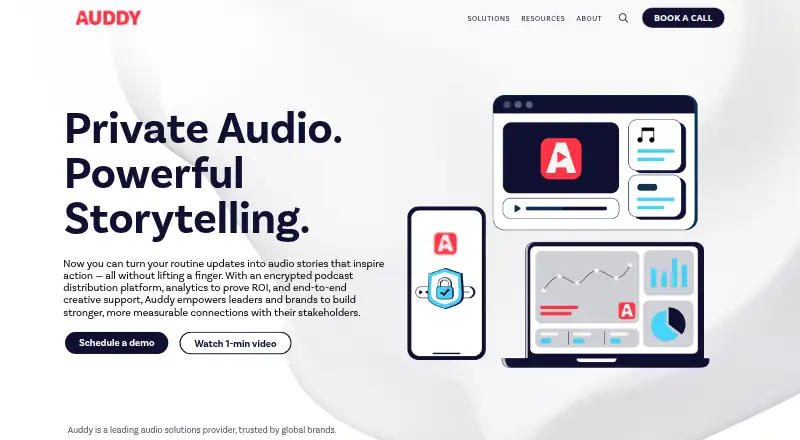
Campfire is Auddy’s private audio distribution platform for organizations that need to send updates to defined audiences.
What Campfire is
Campfire is Auddy’s private audio distribution platform for organizations that need to send updates to defined audiences. It supports investor relations, internal communications, brands, and fan or member communities. Access is invitation-only, and messages can be tailored to audience segments. Engagement tracking includes completion, skips, replays, and drop-off.
Organizations can share secure links through email, intranets, Slack, Teams, or investor-relations tools. The browser experience can use branded, access-controlled microsites; listening on the web requires an internet connection. Campfire also has an encrypted mobile app, with offline listening available in selected app experiences. Auddy states that the service uses encrypted delivery and is SOC 2 certified. Named-user access, listening history, and exportable logs support oversight, with optional enterprise login, automated provisioning, and role-based permissions. Auddy also offers help with planning, guest outreach, recording, editing, and publishing. Pricing is on request and varies by setup and registered listener count.
Good
- Invitation-only access and audience-segmented messages
- Tracks completions, skips, replays, and drop-off
- Named-user access and exportable logs
- Auddy offers editorial and production support
Watch out
- Web listening requires an internet connection
- Pricing is on request and varies by setup
Who it suits
Campfire suits organizations distributing private audio updates to investors, employees, customers, fans, or members. It may also fit teams seeking access controls, engagement tracking, or production support.
Verdict
Campfire combines controlled audio distribution with listener engagement tracking and optional production support. Organizations should consider its quote-based pricing and the internet requirement for web listening.
Plans and prices
From Campfire's own pricing page, checked 4 Oct 2026.
| Plan | Price | What it gives you |
|---|---|---|
| Campfire | Priced on request | Price varies by web/mobile app or self-hosted setup and registered listener count · Base subscription fee plus a usage fee based on registered listeners; contact Auddy for a quote. |
| Campfire custom enterprise | Priced on request | encrypted web or branded mobile app or self-host · usage based on registered listeners · analytics and reporting · base subscription fee plus usage fee |
The facts
Each one read from Campfire's own pages, with the date it was checked.
What it does
- Analytics
- Listener analytics include unique listeners, listening time, completion, drop-off and replays.checked 15 Oct 2026
- API and SDKs
- Auddy’s public Campfire pages do not describe a public API, SDK or developer integration package.checked 15 Oct 2026
- Audience
- Auddy describes Campfire for investor relations, internal communications, brands, and fan or member communities.checked 4 Oct 2026
- Audience segmentation
- Administrators can target channels and updates by role, region, function, shift or persona.checked 15 Oct 2026
- Auditability
- Named-user access, listening history and exportable logs support disclosure and policy reviews.checked 15 Oct 2026
- Audit and access
- Campfire offers named-user access, listen history, exportable logs, and optional enterprise login, automated provisioning, and role-based permissions.checked 4 Oct 2026
- Award
- Auddy said Campfire’s private podcast distribution strategy won an Award of Distinction at the 32nd Communicator Awards.checked 15 Oct 2026
- Branding
- A bespoke app can be fully customized with branding and user journeys, while the web option offers basic branded microsite customization.checked 15 Oct 2026
- Compliance limit
- Campfire complements formal regulatory disclosures and does not replace required filings or announcements.checked 15 Oct 2026
- Content types
- Campfire supports training, company updates, motivational talks, interviews and onboarding content.checked 15 Oct 2026
- Distribution
- Campfire provides invitation-only access and can deliver tailored messages to audience segments.checked 4 Oct 2026
- Funding
- Pembroke VCT reported a £2.5 million Auddy investment round led by a £1.8 million Pembroke investment, with Haatch and Brick as existing investors.checked 15 Oct 2026
- Identity features
- Optional enterprise login, automated provisioning and role-based permissions are available.checked 15 Oct 2026
- Incorporation discrepancy
- Companies House records incorporation on 22 October 2018, while Auddy and LinkedIn describe the operating company as founded in 2020.checked 15 Oct 2026
- Integrations
- Secure links can be distributed through email, intranets, Slack, Microsoft Teams and investor-relations tools.checked 15 Oct 2026
- Legal entity
- Companies House lists the active private company as AUDDY LIMITED, company number 11635341.checked 15 Oct 2026
- Managed production
- Auddy can provide ideation, guest outreach, recording, editing, publishing and project management alongside the software.checked 15 Oct 2026
- Managed support
- Auddy offers creative, editorial, production, and project-management support, including planning, guest outreach, recording, editing, and publishing.checked 4 Oct 2026
- Mobile and offline
- Campfire has an encrypted mobile app, and Auddy says selected app experiences support offline listening while web access requires internet.checked 4 Oct 2026
The company
- Company
- Auddy describes itself as a B2B audio company and says it was founded in 2020.checked 4 Oct 2026
- Company size
- LinkedIn lists Auddy as privately held with 11–50 employees and 23 employees shown.checked 15 Oct 2026
- Founding team
- Auddy says Andrew Craissati founded the business in 2020 with senior executives from Netflix, Warner Music and EMI.checked 15 Oct 2026
- Headquarters
- LinkedIn lists Auddy’s headquarters in London at 55 Baker Street.checked 15 Oct 2026
- Independent company criticism
- A Glassdoor employee review rated Auddy 2.0 out of 5 and criticized unclear identity, management and company values.checked 15 Oct 2026
The full review of Campfire
Campfire is a private audio platform for organizations that need to create, distribute, and measure audio updates. It suits investor-relations and internal-communications teams, as well as brands and member communities that need controlled access. Its combination of segmented delivery and listener tracking is compelling, but custom pricing and the web-listening internet requirement will not suit every audience.
Overview
Campfire replaces open podcast distribution with invitation-only access and messages tailored to audience segments. That makes it a stronger fit for company updates, investor communications, and community content meant for a defined audience than for publishers seeking broad public reach.
Organizations can distribute secure links through email, an intranet, Slack, Teams, or investor-relations tools. The browser experience can be presented through branded, access-controlled microsites, while an encrypted mobile app provides another listening route. Auddy also offers creative, editorial, production, and project-management support, from planning and guest outreach through recording, editing, and publishing. This breadth can help teams without audio-production capacity, though it is an optional service rather than a reason to assume every customer needs managed support.
Key features
Controlled distribution and engagement
Invitation-only access and segmented messages give organizations more control over who receives an update and what they hear. Engagement tracking covers completion, skips, replays, and drop-off, helping teams see where listeners stay engaged or stop listening. These measures are useful for assessing reach and attention, but they do not by themselves establish why listeners behaved that way.
Access controls and security
Named-user access, listen history, and exportable logs support organizations that need an account of who listened and when. Campfire uses encrypted delivery and is SOC 2 certified. Optional enterprise login, automated provisioning, and role-based permissions extend the access model for organizations with more formal identity and administration needs.
Mobile, web, and production support
The encrypted mobile app supports selected offline-listening experiences, useful when listeners cannot rely on connectivity. Web listening, by contrast, requires an internet connection; that is a meaningful constraint for commuters or field teams using the browser option. The browser experience and branded microsites offer a convenient route for organizations that want access-controlled listening without relying solely on the app.
Pricing
Campfire
Campfire has custom pricing: a base subscription fee plus a usage fee based on registered listeners. The quote varies with the web or mobile app setup, self-hosting, and listener count. Organizations should expect costs to scale with their audience and deployment choices, and request a quote before comparing it with fixed-price alternatives. No free plan or trial is specified.
Platforms
Campfire supports Android, iOS, and web. Native mobile apps and an encrypted mobile app are available, with selected app experiences supporting offline listening. The web experience runs in a browser but requires an internet connection for listening.
Who it's for
Campfire is best suited to organizations that need private audio updates, defined audience access, and engagement records: investor-relations teams, internal communicators, brands, and fan or member communities. Its optional production support may also suit teams that want help taking audio from planning to publication. It is less suitable for listeners who need dependable offline playback through the web or buyers who require a published, fixed price to budget.
Pros and cons
Pros
- Precise audience control: Invitation-only access and audience segmentation suit updates that should reach specific groups rather than the public.
- Useful engagement signals: Completion, skips, replays, and drop-off show how listeners interact with each update.
- Auditable access: Named-user access, listen history, and exportable logs support organizations that need a record of listening activity.
- Flexible delivery and support: Secure links can travel through common workplace and investor channels, while optional production services can cover the process from planning through publishing.
Cons
- Costs require a quote: A base fee plus listener-based usage makes budgeting less straightforward, especially as the audience grows.
- Web listening is online-only: The browser experience requires an internet connection, limiting its usefulness when listeners are offline.
- Some administration features are optional: Enterprise login, automated provisioning, and role-based permissions are not part of the baseline offer described.
Alternatives
For a broader comparison of private-audio services, see Private Podcast Platforms.
- Springcast is worth considering for buyers who prefer a published entry price: its Essential plan is €9 a month, excluding VAT, for one podcast and one user, with unlimited episodes and downloads. Campfire is the closer fit when invitation-only segmented distribution and listener engagement tracking are priorities.
- AX3Sonic is a web-based paid option with a free plan and free trial; its listed one-time add-ons include 4.99 USD for five narrations and 5.00 USD for ten AI credits. It is a different option for buyers seeking narration or AI credits rather than Campfire’s private audio distribution.
- Hiro.fm offers a Solo plan for $57 a month, including one creator account, three podcasts, 5,000 downloads per month, three keyword opt-ins, and ten automations. It may suit a creator focused on podcast publishing and audience growth; Campfire is oriented toward controlled organizational updates and access records.
- Supporting Cast is another paid, web-based option.
- Hello Audio offers a Starter plan at $14 a month, billed annually, with one private feed, one public feed, unlimited episodes, and unlimited listeners. It may suit teams that want both private and public feeds with a stated listener allowance; Campfire emphasizes segmented access and engagement tracking.
- Supercast lists an All-in plan at $0.59 a month plus Stripe fees, with unlimited subscriber plans and monthly, annual, and lifetime subscription types. It is a more relevant choice for subscription-plan distribution; Campfire is aimed at organizational audio updates rather than the subscription model described.
- JustCast offers a Starter plan at $9 a month, billed monthly, with two podcasts, unlimited episodes and listeners, and 200 minutes of transcription. It may fit buyers seeking a fixed monthly price and transcription allowance, while Campfire offers access controls and listener-engagement measures.
- Podbean has a free Basic plan with five hours of storage, 100GB monthly bandwidth, three episodes per day, a 100MB single-file limit, and 20 episodes in its RSS feed. It is an option for buyers who want a free podcast-hosting entry point; Campfire is the fit for private, invitation-only distribution.
Verdict
Choose Campfire if your organization needs private audio updates, segmented access, and a record of listener engagement, especially if production support or more formal access controls would help. Its strongest advantage is bringing controlled distribution and listening analytics into one organizational workflow. Look elsewhere if you need fixed, immediately comparable pricing or offline listening in a browser.
Alternatives to Campfire
- 1
Hypecast Analytics
Free planAndroidiOSWebAPI8.1From $139 a month - 2

Podbean
Free planAndroidiOS7.8From $17 a month - 3

Supporting Cast
AndroidiOSWebAPI7.7From $99 a month - 4

Podcast.co
AndroidiOSWebAPI7.1From $19 a month - 5

Springcast
AndroidiOSWebAPI7.1From €9 a month - 6

Transistor
WebAPI7.1From $19 a month