BuildGrid
BuildGrid is a free, open-source service for remote build execution and caching.
What BuildGrid is
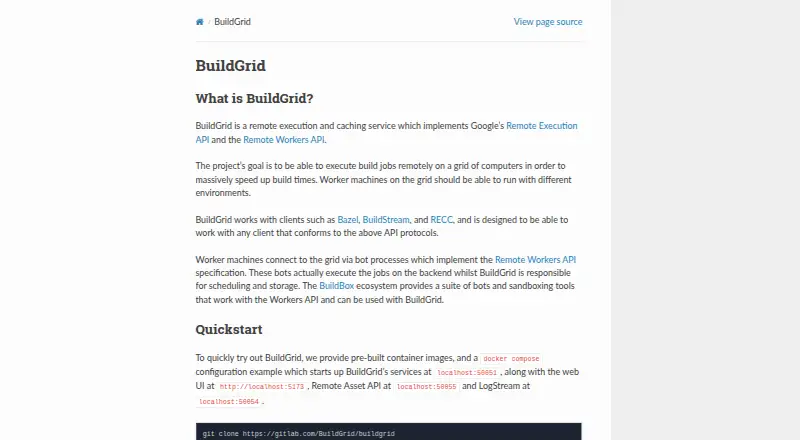
BuildGrid is a free, open-source service for remote build execution and caching. It implements Google’s Remote Execution and Remote Workers APIs: worker bots run jobs while BuildGrid schedules them and stores required data. The project is self-hosted and can distribute work across computers with different environments. Documented clients include Bazel, BuildStream, and RECC, while Trexe is listed among supported build systems; clients following the API protocols can also connect. Deployments use gRPC services in one process or across several processes. Action Cache, ByteStream, and Content Addressable Storage can provide a cache-only instance, and configurable schedulers assign queued jobs to matching bots. LogStream lets execution clients retrieve live worker logs. Bot cohorts and per-instance quotas help share capacity while setting concurrent-job limits. Running a server requires installation, a configuration file, and PostgreSQL. The quickstart supplies container images and a Docker Compose example with local services and a web UI, but that demonstration is not suitable for production scaling. Authorization, TLS, optional ACLs, and configurable monitoring are available.
Good
- Implements Google remote execution APIs
- Supports Bazel, BuildStream, RECC, and Trexe
- Provides content-addressable and action caching
- Can stream live worker logs
- Offers JWT, TLS, and ACL controls
Watch out
- Requires PostgreSQL for server setup
- Docker Compose demo is not for production scaling
- Worker host-tools runner exposes the full filesystem
- Monitoring is disabled by default
Who it suits
BuildGrid suits teams that can self-host remote execution and caching for supported build clients. It is aimed at environments using worker fleets, schedulers, and build-system integrations.
Verdict
BuildGrid provides a self-hosted foundation for distributed builds, caching, scheduling, and worker logs. Deployment requires infrastructure knowledge, and the quickstart configuration is not a production-scale setup.
The facts
Each one read from BuildGrid's own pages, with the date it was checked.
What it does
- Authorization
- BuildGrid supports JWT or request-header authorization, with optional ACL configuration for controlling access to requests.checked 7 Oct 2026
- Build speed
- The project aims to speed up builds by executing jobs remotely across a grid of computers with different environments.checked 7 Oct 2026
- Caching
- Its Action Cache, ByteStream, and Content Addressable Storage services together support a cache-only instance.checked 7 Oct 2026
- Compatible clients
- The documentation names Bazel, BuildStream, and RECC as clients, and says BuildGrid is designed to work with clients that conform to its API protocols.checked 7 Oct 2026
- Database requirement
- The getting-started guide says starting a BuildGrid server requires installation, a configuration file, and a PostgreSQL database.checked 7 Oct 2026
- Deployment
- A deployment consists of gRPC services that can run in one process or across multiple processes for more granular scaling.checked 7 Oct 2026
- How it works
- Worker bots execute jobs on the backend while BuildGrid handles scheduling and storage.checked 7 Oct 2026
- Live logs
- The separate LogStream service lets execution clients retrieve live logs from worker machines during remote execution.checked 7 Oct 2026
- Monitoring
- Monitoring is off by default; when enabled, BuildGrid can publish metrics and server logs to configured destinations.checked 7 Oct 2026
- Notable deployment limit
- The getting-started guide says the Docker Compose demo is not suitable for production scaling.checked 7 Oct 2026
- Purpose
- BuildGrid is a remote execution and caching service that implements Google’s Remote Execution API and Remote Workers API.checked 7 Oct 2026
- Quickstart
- The quickstart provides pre-built container images and a Docker Compose example that starts BuildGrid services, a web UI, Remote Asset API, and LogStream locally.checked 7 Oct 2026
- Resource sharing
- Bot cohorts and per-instance quotas can help share worker capacity across instances while setting minimum and maximum concurrent job slots.checked 7 Oct 2026
- Storage
- The Content Addressable Storage service persistently stores data needed during a job, and BuildGrid supports CAS indices stored in Redis or PostgreSQL.checked 7 Oct 2026
- Support
- The project documentation points users to a BuildTeamWorld Slack channel and GitLab bug tracking.checked 7 Oct 2026
- Support channel
- The documentation links to a BuildGrid Slack channel and an invite link.checked 7 Oct 2026
- Transport security
- The server configuration supports TLS credentials, including server keys and certificates and client certificates.checked 7 Oct 2026
- Worker scheduling
- BuildGrid queues execution jobs and assigns them to matching bots using configurable scheduler components.checked 7 Oct 2026
- Worker security
- The documentation warns that the host-tools runner gives actions access to the worker machine’s full filesystem and describes a userchroot runner for sandboxing.checked 7 Oct 2026
The company
- Founded
- 2018checked 28 Sep 2026
Where it runs
- Worker platforms
- The documented BuildBox worker tools support Linux, AIX, and Solaris.checked 7 Oct 2026