
BAKLOG
BAKLOG is a desktop backlog dashboard that brings game libraries from many storefronts into one local view.
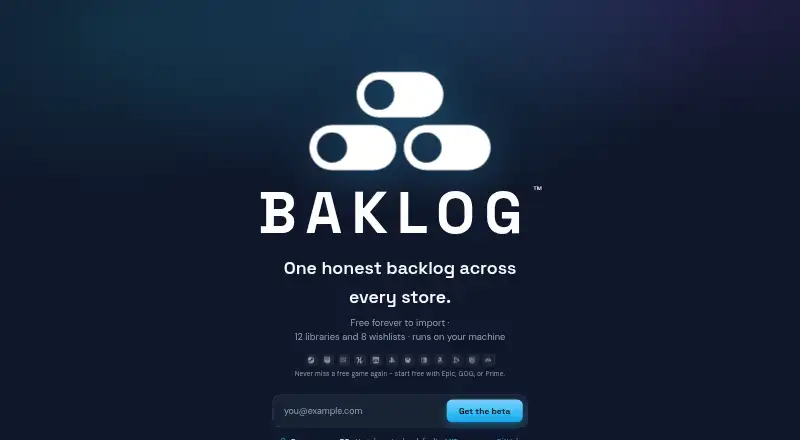
What BAKLOG is
BAKLOG is a desktop backlog dashboard that brings game libraries from many storefronts into one local view. It supports 12 library sources, including Steam, Epic, GOG, PlayStation, Xbox, Amazon, Battle.net, Ubisoft, Nintendo, itch.io, Humble, and EA App. Eight wishlist sources feed its deal radar, with prices displayed in the user’s currency. Cross-store deduplication, combined playtime and review scores, and a filter for DLC or other non-game items help organize a collection. Up to three custom-named Picks tabs provide additional ways to sort choices. Claimable Now gathers active giveaways from services such as GamerPower, IsThereAnyDeal, and the Epic Store, while hiding games already owned; this feature is included in the free tier. The dashboard also supplies more than 300 statistics, including completion AVG, backlog OPS, value-per-hour, and WAR-style measures. BAKLOG runs on Linux, macOS, and Windows, is open source under the MIT license, and is currently in open beta. Catalogs remain local by default, credentials use AES-256-GCM encryption at rest, and the desktop app has no telemetry by default.
Good
- Supports 12 storefront library sources
- Eight wishlist sources show deal prices
- Cross-store deduplication and combined statistics
- Claimable Now is included in free tier
- MIT-licensed open-source desktop app
- Catalogs stay local by default
Watch out
- Free tier refreshes one store at a time
- Closed-app scheduled refresh requires Pro
- No mobile apps
- Currently in open beta
Who it suits
BAKLOG suits players with libraries spread across multiple stores who want one backlog view, wishlist deal tracking, and playtime or review data. It also fits users who prefer local catalogs and open-source desktop software on Linux, macOS, or Windows.
Verdict
Choose BAKLOG if you want a unified, local dashboard for broad game libraries, giveaways, and detailed backlog statistics. Look elsewhere if you need mobile apps or automatic queued and scheduled refreshes without Pro.
Plans and prices
From BAKLOG's own pricing page, checked 20 Oct 2026.
| Plan | Price | What it gives you |
|---|---|---|
| Free | Free | Library import and browsing · all 12 stores · eight wishlist sources · one-store-at-a-time manual refresh · cached achievement percentages · Claimable Now full-game feed · Free forever |
| Pro | $5 a month | Bulk stale-store refresh · refresh while app is closed · deep achievement/trophy re-pulls · no sponsored deal cards · bonus claimables feed · opt-in cloud sync · $5/mo |
| Pro | $50 a year | Bulk stale-store refresh · refresh while app is closed · deep achievement/trophy re-pulls · no sponsored deal cards · bonus claimables feed · opt-in cloud sync · $50/yr |
The facts
Each one read from BAKLOG's own pages, with the date it was checked.
What it does
- Analytics
- The dashboard advertises more than 300 statistics and game-backlog metrics including completion AVG, backlog OPS, value-per-hour and WAR.checked 20 Oct 2026
- API surface
- The local server exposes internal /api JSON and server-sent-event endpoints for the dashboard, but the documentation does not describe a hosted public developer API.checked 20 Oct 2026
- Availability
- BAKLOG is in open beta; the site says users can request a packaged download link by email or clone and run the source on Windows, macOS, or Linux.checked 7 Oct 2026
- Cloud sync
- Pro can upload catalogs and personal statuses for account-scoped cross-machine browsing, while credentials remain local.checked 20 Oct 2026
- Credential encryption
- Credentials are encrypted with AES-256-GCM and keys are stored in the Windows Credential Manager, macOS Keychain or Linux Secret Service.checked 20 Oct 2026
- Cross-store deduplication
- The dashboard merges matching games from different stores into a single table.checked 20 Oct 2026
- Deal radar
- Wishlist prices are shown in the user's currency and the radar can hide games already owned elsewhere.checked 20 Oct 2026
- Distribution status
- BAKLOG is in open beta and packaged downloads are sent through an email signup or provided through GitHub Releases.checked 20 Oct 2026
- Documentation depth
- The repository includes guides for installation, store connections, dashboard use, refresh and enrichment, profiles, troubleshooting, FAQ and support.checked 20 Oct 2026
- Giveaway data sources
- The free-game feed uses GamerPower, IsThereAnyDeal and Epic Store data.checked 20 Oct 2026
- Giveaway feed
- Claimable Now aggregates active full-game giveaways from Epic, GOG, Steam, Prime and other sources, excluding titles already owned.checked 20 Oct 2026
- Giveaways
- Claimable Now aggregates active giveaways from sources including GamerPower, IsThereAnyDeal, and the Epic Store, hides games the user already owns, and is included in the free tier.checked 7 Oct 2026
- Library noise filtering
- Built-in rules hide non-game entries such as DLC, soundtracks, skins and store applications from the main count.checked 20 Oct 2026
- Library tools
- Features include cross-store deduplication, combined playtime and review scores, a filter for DLC and other non-game items, and up to three custom-named Picks tabs.checked 7 Oct 2026
- License
- The full application source is released under the MIT license.checked 20 Oct 2026
- Limit: cloud deletion
- Hosted mirror objects currently require owner-side deletion through the Supabase dashboard or storage tools because an in-app delete path is only planned.checked 20 Oct 2026
- Limit: code signing
- The architecture notes Windows signing is gated, while local builds and macOS/Linux builds remain unsigned.checked 20 Oct 2026
- Local-first design
- The architecture runs a Python server on 127.0.0.1:8765 with local fetcher subprocesses and no multi-tenant catalog backend.checked 20 Oct 2026
- Network privacy
- Store requests originate from the user's machine and IP, while the marketing site receives only stated analytics, signup, report and public-feed traffic.checked 20 Oct 2026
- Open source
- The full app is published under the MIT license, and the site links to a public repository and a published threat model.checked 7 Oct 2026
Money
- Free refresh limit
- The free tier permits on-demand refresh of one store at a time and has no closed-app background refresh.checked 20 Oct 2026
Where it runs
- Limit: macOS packaging
- The public architecture notes that the frozen macOS zip was deferred and remains notify-only until shipped.checked 20 Oct 2026
- Linux limitation
- Linux support is described as limited; Amazon Games launcher and GOG Galaxy local sources are unavailable, and the packaged Linux build is experimental without a tray.checked 20 Oct 2026
- macOS limitation
- macOS supports the app but local Amazon Games launcher data is unavailable there and GOG Galaxy local access is limited to macOS rather than Linux.checked 20 Oct 2026
The full review of BAKLOG
BAKLOG is a desktop command center for consolidating game libraries, wishlists, promotions, and backlog data from many storefronts. It suits players whose collections are scattered across platforms and who enjoy making choices from detailed statistics. Its local-first design and unusually broad coverage stand out, while the open-beta status, desktop-only availability, and constrained free refresh workflow require a realistic assessment.
Overview
Instead of reducing a backlog to a checklist, BAKLOG builds a decision dashboard around owned games, playtime, review context, deals, and giveaways. It can compare promotions with games already in a collection and surface a practical next choice. That makes it particularly useful for multi-store PC and console users; people wanting a phone companion or a polished, continuously updating service will find important gaps.
Key features
One catalog across 12 stores
BAKLOG imports libraries from Steam, Epic, GOG, PlayStation, Xbox, Amazon, Battle.net, Ubisoft, Nintendo, itch.io, Humble, and EA App. Cross-store deduplication prevents the same title from dominating the view, while merged playtime and review scores provide broader context than any single storefront. A filter for DLC and other non-game entries keeps the playable backlog cleaner. Up to three custom-named Picks tabs provide focused groupings, though users who need a large taxonomy of lists may outgrow that limit.
Wishlists, giveaways, and selection tools
Eight wishlist sources power deal radar, with prices converted to the user's currency. Claimable Now collects active full-game giveaways from services including GamerPower, IsThereAnyDeal, and the Epic Store, and removes titles already owned; its inclusion in the free tier makes it a practical way to avoid duplicate claims. The dashboard goes far beyond a basic count, offering more than 300 statistics and baseball-inspired measures such as completion AVG, backlog OPS, value-per-hour, and WAR for a next pick. These metrics reward analytical players, although they may be excessive for anyone who simply wants a short queue.
Refresh, privacy, and security
Free users refresh one store at a time manually, while the open app automatically refreshes one stale store roughly every 30 minutes. Pro adds queued bulk refresh and scheduled refresh while the app is closed, a substantial difference for large collections. Catalogs remain local by default and store fetches run from the user's computer and IP. Optional Pro cloud sync covers catalogs and personal statuses, but credentials stay local. BAKLOG says credentials are encrypted at rest with AES-256-GCM and stored through Windows Credential Manager, macOS Keychain, or Linux Secret Service. Desktop telemetry is off by default, catalog data is not sold, and the application is MIT-licensed with a public repository and threat model.
Pricing
Free
The Free plan costs nothing. It includes library import and browsing across stores, automatic fetch on connect, Claimable Now for full-game giveaways, and the one-store-at-a-time refresh workflow. It is a strong starting point for occasional check-ins, but manual sequencing and the lack of closed-app refreshes make it less convenient for a very large or frequently changing collection.
Pro
Pro has custom pricing. It removes sponsored deal cards and adds refresh while the app is closed, queued bulk refresh, deep achievement and trophy synchronization, opt-in cloud sync, and a bonus claimables feed. Deal and watchlist alerts are marked as coming soon. Pro is the sensible fit for users who want automation, richer console progress data, or multi-device catalog continuity; the absence of a published price makes the upgrade harder to compare before committing.
Platforms
BAKLOG runs on Linux, macOS, and Windows. It has no mobile apps. The project is in open beta: users can request a packaged download link by email or clone and run the source on those desktop systems. Community Discord, GitHub, and direct email support provide avenues for help, but beta software remains a less predictable choice than an established release.
Who it's for
Choose BAKLOG if you own games across several storefronts, want local control of catalog data, and will use statistics to decide what to play. It is also well suited to bargain hunters who want wishlist prices and giveaways checked against existing ownership. Look elsewhere if phone access is essential, if you need unlimited custom organization, or if refreshes must happen automatically without paying for Pro.
Pros and cons
- Pro: Twelve library integrations create a genuinely broad cross-store view.
- Pro: Deduplication, merged playtime and reviews, and non-game filtering make a large catalog more usable.
- Pro: Giveaway aggregation and currency-aware wishlist pricing connect backlog management with deal discovery.
- Pro: Local-by-default storage, encrypted credentials, no default telemetry, and open-source code support a privacy-conscious workflow.
- Con: Free refreshes are sequential and limited; closed-app scheduling requires Pro.
- Con: There are no mobile apps, so the dashboard is confined to desktop systems.
- Con: Open-beta distribution by email request or source checkout adds friction for users expecting a conventional download.
- Con: Picks tabs stop at three, and Pro pricing is not published.
Alternatives
For a wider comparison, see Game Backlog Trackers.
- Logged is the better choice for cross-platform tracking that includes Android, iOS, web, and desktop, with unlimited tracking, imports, and exports on its free plan.
- GameTrack fits users who want mobile apps, unlimited games, and three custom lists, with an optional $3.99-per-month upgrade.
- MioLog is a free, open-source, offline-first option with Android, iOS, and web access and no account requirement.
- Playloggr offers Android and web access with an unlimited library and wishlist on its free tier.
- Backlog Zero is a macOS and Windows alternative with every feature included, no account, and pay-what-you-want pricing.
- Cartridge is an iOS-focused tracker with stacks, reviews, and social-link capture, plus a $3.99 monthly Plus plan.
- Grouvee is a web-based tracker built and maintained by one person, with shelves, lists, ratings, and reviews.
- Infinite Backlog is a free web service with optional Patreon supporter perks.
Verdict
BAKLOG is a strong recommendation for desktop players with fragmented libraries who want one private, statistics-heavy place to choose games and monitor deals. Its store breadth, giveaway handling, and local architecture are the main reasons to choose it. Look elsewhere if mobile access, mature non-beta delivery, or unattended refreshes on a free plan matter more than analytical depth.
Getting started
- Open the BAKLOG website
- Request a packaged download link by email
- Alternatively clone the public repository
- Run the source on Windows, macOS, or Linux
- Import supported store libraries and wishlists
Limits worth knowing
The free plan allows manual refreshes one store at a time and automatically refreshes one stale store about every 30 minutes while the app is open. Queued bulk refresh and refresh while the app is closed are Pro features.
Questions
What does BAKLOG cost?
The Free plan is listed as free. A Pro plan is also offered with additional refresh, sync, and deal features.
Which platforms support BAKLOG?
BAKLOG runs on Linux, macOS, and Windows. There are no mobile apps.
Is BAKLOG open source?
Yes. The full app is published under the MIT license, with a public repository and threat model.
How does the free refresh system work?
Free users manually refresh one store at a time. While open, the app auto-refreshes one stale store about every 30 minutes.
Does BAKLOG hide owned giveaway games?
Yes. Claimable Now aggregates active giveaways and hides games already in the user’s library.