AxonOps Schema Registry
AxonOps Schema Registry manages schemas used with Apache Kafka and is an API-compatible alternative to Confluent Schema Registry.
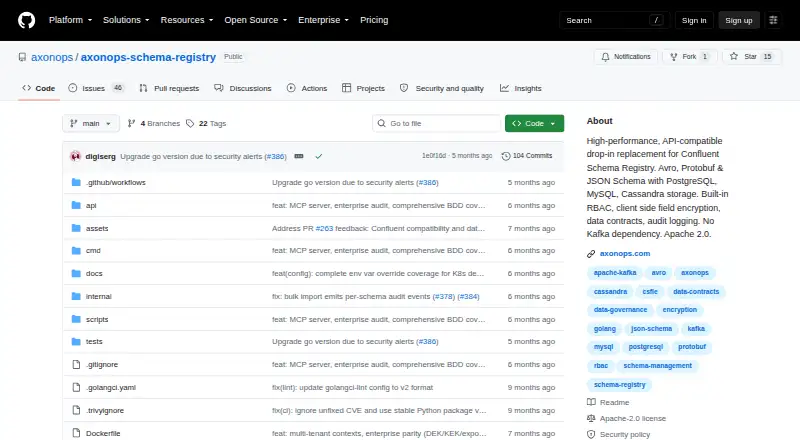
What AxonOps Schema Registry is
AxonOps Schema Registry manages schemas used with Apache Kafka and is an API-compatible alternative to Confluent Schema Registry. It supports Avro, Protobuf, and JSON Schema, with schema references and seven compatibility modes. Schema data can be stored in PostgreSQL, MySQL, or Cassandra, without using Kafka as the storage backend. The project says existing Confluent serializers and Java, Go, and Python Kafka clients can connect by changing the registry URL. Security options include Basic Auth, API keys, JWT, LDAP/AD, OIDC, mTLS, four RBAC roles, rate limiting, and automatic TLS certificate reload. Audit events can be sent to several destinations, including files, syslog, and webhooks. Client-side field encryption supports a DEK/KEK registry and integrations with HashiCorp Vault and OpenBao Transit. Data contracts add metadata and rules to schemas. The built-in MCP server is marked beta. The free, Apache 2.0-licensed registry runs as a Docker container or can be built from source; Cassandra storage requires version 5.0 or later.
Good
- Supports Avro, Protobuf, and JSON Schema
- Stores schemas in PostgreSQL, MySQL, or Cassandra
- Includes multiple authentication and access-control options
- Free and Apache 2.0 licensed
- Runs as a Docker container or built binary
Watch out
- Cassandra storage requires version 5.0 or later
- Built-in MCP server is marked beta
Who it suits
It suits teams managing Kafka event schemas that want multiple schema formats, compatibility settings, and configurable storage. Its deployment model is self-hosted, so it fits teams able to run and maintain the service themselves.
Verdict
AxonOps Schema Registry offers broad schema-format, storage, and security options in a free self-hosted package. Teams using Cassandra should confirm they have version 5.0 or later.
Plans and prices
From AxonOps Schema Registry's own pricing page, checked 30 Sep 2026.
| Plan | Price | What it gives you |
|---|---|---|
| AxonOps Schema Registry | Free | No hidden costs · no premium tiers · no license keys · 100% free and open source; Apache 2.0 licensed |
| Free | Free | all features · no premium tiers · no license keys · forever |
The facts
Each one read from AxonOps Schema Registry's own pages, with the date it was checked.
What it does
- AI integration
- Its built-in MCP server is marked beta and supports AI clients including Claude, Cursor, VS Code Copilot, and Windsurf.checked 30 Sep 2026
- API compatibility
- The registry implements the Confluent Schema Registry REST API v1, including enterprise endpoints.checked 15 Oct 2026
- API documentation
- A built-in Swagger interface is available at the /docs endpoint.checked 15 Oct 2026
- Audit logging
- Audit events can be sent to stdout, rotating files, syslog, and webhooks in JSON or CEF formats.checked 15 Oct 2026
- Authentication
- Built-in authentication methods include Basic, API keys, JWT, LDAP/Active Directory, OIDC, and mutual TLS.checked 15 Oct 2026
- Business activities
- Companies House lists software publishing and information-technology consultancy and service activities for AxonOps Limited.checked 15 Oct 2026
- Client compatibility
- The maker says existing Confluent serializers and Java, Go, and Python Kafka clients work by pointing them at the registry URL.checked 30 Sep 2026
- Client libraries
- Existing Confluent serializers for Java, Go, and Python can work by changing the registry URL.checked 15 Oct 2026
- Compatibility modes
- The product supports seven compatibility modes, including backward, forward, full, and transitive variants.checked 15 Oct 2026
- Data contracts
- Data contracts attach metadata tags and domain, migration, and encoding rules to schemas, with defaults and per-subject overrides.checked 30 Sep 2026
- Deployment
- The registry is a single statically linked binary of about 50 MB and can run as a Docker container or be built from source.checked 30 Sep 2026
- Deployment footprint
- The project describes a statically linked binary of about 50 MB with no runtime dependencies.checked 15 Oct 2026
- Developer prerequisites
- The development guide lists Go 1.26 or newer and Docker, with Java 17+, Maven, and Python 3 optional for compatibility tests.checked 15 Oct 2026
- Documentation depth
- Documentation covers installation, configuration, storage, schema types, compatibility, security, auditing, deployment, monitoring, migration, encryption, exporters, MCP, and troubleshooting.checked 15 Oct 2026
- Encryption
- A DEK and KEK registry provides client-side field-level encryption compatible with Confluent serializers.checked 15 Oct 2026
- Field encryption
- Client-side field encryption includes a DEK/KEK registry and production-ready integrations with HashiCorp Vault and OpenBao Transit.checked 30 Sep 2026
- High availability
- Multiple stateless instances can run behind a load balancer using database-level locking with PostgreSQL or MySQL.checked 15 Oct 2026
- Kafka dependency
- Kafka is not required for schema storage because the service uses external databases.checked 15 Oct 2026
- KMS integrations
- Production KMS integrations include HashiCorp Vault and OpenBao Transit.checked 15 Oct 2026
- Latest release
- Release v0.4.0-mcp-phase7 added MCP and enterprise audit features, Kubernetes environment-variable coverage, a MySQL deadlock retry, per-schema bulk-import audit events, and a Go upgrade prompted by security alerts.checked 15 Oct 2026
The company
- Company founded
- LinkedIn gives AxonOps a 2022 founding year.checked 15 Oct 2026
- Company headquarters
- LinkedIn identifies AxonOps headquarters as London, United Kingdom.checked 15 Oct 2026
- Company size
- LinkedIn lists AxonOps as having 11–50 employees and 13 discoverable employees.checked 15 Oct 2026
- Headquarters
- London, United Kingdomchecked 23 Sep 2026
The full review of AxonOps Schema Registry
AxonOps Schema Registry manages Apache Kafka schemas through an API-compatible alternative to Confluent Schema Registry. It is best suited to teams that want to self-host and choose their own database backend. Its broad format and security support are compelling, though Cassandra users need version 5.0 or later.
Overview
The registry supports Avro, Protobuf, and JSON Schema, including schema references and seven compatibility modes. It can store schemas in PostgreSQL, MySQL, or Cassandra, so Kafka does not have to double as the registry’s storage backend. That flexibility makes it easier to fit into varied infrastructure, but the Cassandra option has a firm version requirement: Cassandra 5.0 or later.
The project is a single statically linked binary of about 50 MB. Teams can run it in Docker or build it from source, giving self-hosters a compact deployment option without requiring Kafka for storage. The trade-off is that operating the registry remains the team’s responsibility.
Key features
Existing Confluent serializers and Java, Go, and Python Kafka clients can work by pointing them at the registry URL, according to the maker. This offers a path for teams using those clients to adopt the registry without changing their serializer choice.
Compatibility controls cover NONE, BACKWARD, BACKWARD_TRANSITIVE, FORWARD, FORWARD_TRANSITIVE, FULL, and FULL_TRANSITIVE. The range lets teams choose how strictly schema changes must remain compatible, from no compatibility requirement to full compatibility across versions.
Security options include Basic Auth, API keys, JWT, LDAP/AD, OIDC, mutual TLS, four RBAC roles, rate limiting, and TLS certificate auto-reload. Audit events can be emitted to stdout, rotating files, syslog over TCP/TLS, or webhooks in JSON or CEF format. These options suit organizations that need multiple authentication approaches and auditable access, though the available facts do not establish how those controls compare with a managed service.
Client-side field encryption includes a DEK/KEK registry and production-ready integrations with HashiCorp Vault and OpenBao Transit. Data contracts add metadata tags and domain, migration, and encoding rules to schemas, with defaults and per-subject overrides. An integrated MCP server connects with AI clients including Claude, Cursor, VS Code Copilot, and Windsurf, but it is marked beta and should not be treated as a settled production capability.
Pricing
AxonOps Schema Registry costs nothing. The plan is billed 100% free and open source, licensed under Apache 2.0, with no hidden costs, premium tiers, or license keys. There are no paid product tiers to graduate into; teams that need commercial support can inquire about AxonOps support plans, while community issues and contributions are also welcome.
This is a strong fit for teams able to self-host and operate the software, since the free plan is not described as a capped trial. It is less suitable for readers who want a fully managed registry or prefer to pay a vendor to take on deployment and operations.
Platforms
AxonOps Schema Registry is available as an API and runs on Linux in a self-hosted deployment. Docker and source builds offer two deployment routes, but this is not presented as a hosted web application.
Who it's for
Choose it if you manage Kafka schemas and want control over storage, deployment, security, and schema policy without a license fee. It particularly suits teams already using PostgreSQL or MySQL, or Cassandra 5.0 and later, and those whose clients use Confluent serializers or Java, Go, or Python Kafka libraries. Look elsewhere if self-hosting is undesirable, or if your Cassandra estate is older than 5.0 and you need Cassandra as the backend.
Pros and cons
Pros
- Broad storage choice: PostgreSQL, MySQL, and Cassandra are supported, and Kafka is not required as the storage backend.
- Extensive security and audit options: Authentication, RBAC, rate limiting, certificate reload, and multiple audit destinations support varied operational needs.
- Free, open-source licensing: The Apache 2.0 plan has no premium tiers, hidden costs, or license keys.
- Useful schema governance: Seven compatibility modes, data contracts, and field encryption support more than basic schema storage.
Cons
- Self-hosting is required: Teams must provide and operate their own deployment rather than rely on a managed AxonOps service.
- Cassandra has a high minimum version: The backend requires Cassandra 5.0 or later, excluding earlier installations.
- The MCP integration is beta: Teams should be cautious about depending on it for production workflows.
Alternatives
- Schema Registry Software is the category directory for comparing more options.
- AWS Glue Schema Registry is another free option, with an API and web platform; its free allowance includes up to 100 registries and 10,000 schema versions per Region per account. Consider it when those stated account-level limits suit your needs.
- Karapace is a free, self-hosted Linux/API option whose free plan includes Schema Registry and REST proxy, up to 250 KiB/s throughput, retention up to 3 days, and up to 5 topics with two partitions each. Choose it if those explicit limits and included proxy match your workload.
- Buf Schema Registry offers a free Community plan with one private repository, unlimited public repositories, and Community Slack support. Its Teams plan is $0.50 a month. It may suit readers who want a repository-based offering with a published community support channel.
- Sourcemeta One has a free self-hosted Community edition with a subset of functionality under Business Source License 1.1, with releases transitioning to AGPL-3.0-or-later after four years. Consider it if that licensing and reduced edition are acceptable.
- Confluent Cloud has a free Basic plan with serverless, fully managed clusters, autoscaling Kafka resources, and more than 80 fully managed connectors. Pick it if managed Kafka infrastructure is a priority over AxonOps’s self-hosted registry model.
- Yandex Cloud Schema Registry is a free-of-charge web option; its plan has custom pricing.
- Raystack Stencil is another free option available across API, Linux, macOS, self-hosted, and Windows platforms.
- Dataphos Schema Registry is a free API and self-hosted option; its documentation identifies it as a Syntio product.
Verdict
AxonOps Schema Registry is a strong choice for Kafka teams that want a free, self-hosted registry with broad schema formats, selectable database storage, and substantial built-in security. Its main reason to choose it is the combination of operational control and a wide feature set without license fees. Look elsewhere if you need a managed service, or if your Cassandra deployment is earlier than 5.0.
Alternatives to AxonOps Schema Registry
- 1

Redpanda
Free planWebAPILinuxmacOS7.4Free plan - 2

AWS Glue DataBrew
WebAPI7.2 - 3

Confluent Cloud
Free planWebAPILinux7.1From $385 a month - 4
Lenses
Free planWebAPILinuxmacOS7.1From $4 a year - 5

Google Cloud Pub/Sub
Free planWebAPI6.9$40 usage-based - 6

Buf Schema Registry
Free planWebAPISelf-hosted6.7From $0.50 a month