
AWS Transform MGN (formerly AWS Application Migration Service)
AWS Transform MGN automates rehosting physical, virtual, and cloud servers as Amazon EC2 instances.
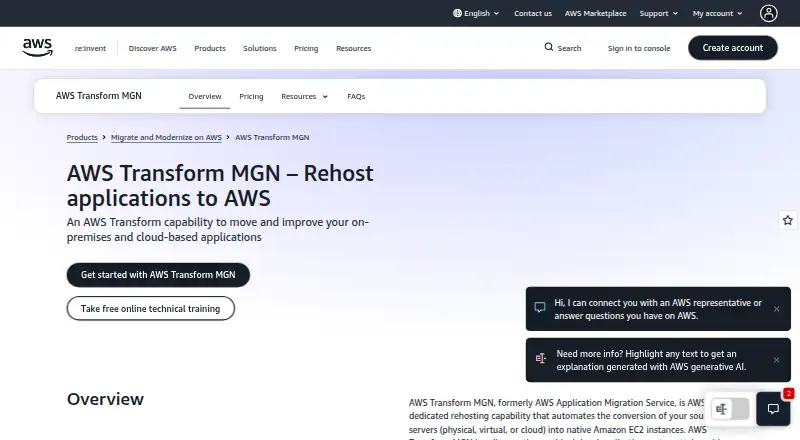
What AWS Transform MGN (formerly AWS Application Migration Service) is
AWS Transform MGN automates rehosting physical, virtual, and cloud servers as Amazon EC2 instances. It continuously replicates source data at the block level, converts servers for AWS, and coordinates cutover with minimal downtime. Teams can follow an AWS Transform workflow or manage migration steps in the MGN console, switching between them without losing progress. Sources include physical servers, VMware vSphere, Microsoft Hyper-V, other on-premises infrastructure, public clouds, and systems moving across AWS Regions, Availability Zones, or accounts. After launch, built-in or custom actions can configure disaster recovery, upgrade operating systems, convert licenses, or install CloudWatch Agent. Servers can be organized into applications and waves for launch, cutover, archival, and configuration operations. MGN supports x86 sources and replication volumes up to 16 TB. A 90-day free period applies per source server; AWS infrastructure for replication, testing, and cutover is charged separately, and continued replication is charged per hour afterward.
Good
- Replicates source servers continuously at the block level
- Supports several on-premises and cloud migration sources
- Switch workflows without losing migration progress
- Post-launch actions include OS upgrades and disaster recovery configuration
- Operations can be managed at server, application, or wave level
Watch out
- Supports x86 source servers only
- Replication volumes larger than 16 TB are unsupported
- AWS infrastructure charges separately during the free period
- Installation or replication support is limited to supported operating systems
Who it suits
It suits teams moving supported x86 servers to AWS that need to coordinate migrations across applications or waves. Check the 16 TB replication-volume ceiling and account for separate AWS infrastructure charges.
Verdict
AWS Transform MGN combines server replication, cutover orchestration, and post-launch actions for rehosting to EC2. Its 90-day service period does not include the AWS infrastructure charges, and its source and volume limits merit checking before a migration.
Plans and prices
From AWS Transform MGN (formerly AWS Application Migration Service)'s own pricing page, checked 30 Sep 2026.
| Plan | Price | What it gives you |
|---|---|---|
| Free period | Free | AWS infrastructure used for replication, testing, or cutover is charged separately · after the free period, continued replication is charged per hour · 2,160 hours (90 days when used continuously) per source server; service charge only |
The facts
Each one read from AWS Transform MGN (formerly AWS Application Migration Service)'s own pages, with the date it was checked.
What it does
- Availability
- AWS says MGN is available in commercial AWS Regions and both AWS GovCloud (US) Regions.checked 30 Sep 2026
- Compliance
- AWS says MGN retains certifications including FedRAMP High, HIPAA, PCI DSS, ISO, and SOC 1, 2, and 3.checked 30 Sep 2026
- Management at scale
- MGN groups servers into applications and waves, with launch, cutover, archival, and configuration operations available at server, application, or wave level.checked 30 Sep 2026
- Migration paths
- Customers can use an agentic AWS Transform workflow or manage rehosting steps directly in the MGN console, and switch paths without losing progress.checked 30 Sep 2026
- Migration sources
- MGN supports migrations from physical servers, VMware vSphere, Microsoft Hyper-V, other on-premises infrastructure, other public clouds, and across AWS Regions, Availability Zones, or accounts.checked 30 Sep 2026
- Modernization
- Built-in and custom post-launch actions include disaster recovery configuration, operating system upgrades, license conversion, and CloudWatch Agent installation.checked 30 Sep 2026
- Monitoring and integrations
- MGN documentation describes monitoring with Amazon CloudWatch, CloudWatch Events, CloudWatch Logs, and AWS CloudTrail.checked 30 Sep 2026
- Product name
- AWS Application Migration Service was renamed AWS Transform MGN on June 8, 2026.checked 30 Sep 2026
- Purpose
- AWS Transform MGN automates rehosting physical, virtual, and cloud servers as native Amazon EC2 instances.checked 30 Sep 2026
- Replication and cutover
- It continuously replicates source servers at the block level, converts them for AWS, and orchestrates cutover with minimal downtime.checked 30 Sep 2026
- Security
- MGN requires TLS 1.2 or later, uses TLS and IAM for authentication, and recommends EBS encryption and limiting replication server exposure to the public internet.checked 30 Sep 2026
- Support
- AWS documentation says support for installation or replication issues is limited to operating systems listed as supported.checked 30 Sep 2026
- Supported infrastructure limit
- MGN supports x86 source servers and replication volumes up to 16 TB; larger volumes are not supported.checked 30 Sep 2026
The company
- Founded
- 2006checked 28 Sep 2026
The full review of AWS Transform MGN (formerly AWS Application Migration Service)
Overview
AWS Transform MGN is a server rehosting service that automates the move of physical, virtual, and cloud servers into native Amazon EC2 instances. AWS Application Migration Service was renamed AWS Transform MGN on June 8, 2026. The service focuses on replicating servers, converting them for AWS, and coordinating cutover while aiming to keep downtime minimal.
Migration teams can work through an agentic AWS Transform workflow or manage rehosting steps in the MGN console. They can switch between these approaches without losing progress. For a wider category view, see our Cloud Migration Tools list.
Key features
Replication and migration sources
MGN continuously replicates source servers at the block level before conversion and cutover. It supports migrations from physical servers, VMware vSphere, Microsoft Hyper-V, other on-premises infrastructure, and other public clouds. It can also move workloads across AWS Regions, Availability Zones, and accounts.
Its supported infrastructure has a clear boundary: source servers must be x86, and replication volumes can be up to 16 TB. Larger volumes are not supported, so this limit should be checked before planning a migration.
Post-launch actions
Built-in and custom post-launch actions support follow-up work such as disaster recovery configuration, operating system upgrades, license conversion, and CloudWatch Agent installation. These options can connect the migration process with configuration tasks after launch.
Organizing work at scale
MGN lets teams group servers into applications and migration waves. Launch, cutover, archival, and configuration operations are available at server, application, or wave level. This provides more than one scope for managing migration work, from an individual server to a grouped set of workloads.
Discovery, monitoring, and security
Discovery and assessment and continuous replication are listed capabilities, as is database migration. Monitoring documentation describes integration with Amazon CloudWatch, CloudWatch Events, CloudWatch Logs, and AWS CloudTrail.
MGN requires TLS 1.2 or later and uses TLS and IAM for authentication. AWS recommends EBS encryption and limiting replication server exposure to the public internet. AWS also says the service retains certifications including FedRAMP High, HIPAA, PCI DSS, ISO, and SOC 1, 2, and 3. Support for installation or replication issues is limited to operating systems listed as supported.
Pricing
MGN is a paid service with a 90-day free period. The listed free-period price is free, billed for 2,160 hours (90 days when used continuously) per source server. This covers the service charge only; AWS infrastructure used for replication, testing, or cutover is charged separately. After the free period, continued replication is charged per hour. The product is also listed as having a free plan, while its pricing details describe this time-limited free period; no separate free-trial offer is listed.
Platforms
MGN is listed for API, Linux, web, and Windows, with a SaaS deployment model. AWS says the service is available in commercial AWS Regions and both AWS GovCloud (US) Regions.
Who it's for
MGN is aimed at organizations moving supported x86 server workloads into Amazon EC2, including migrations from on-premises environments, other public clouds, or other AWS locations and accounts. Its application and wave grouping, multiple management scopes, and post-launch actions suit teams coordinating migrations across sets of servers. The 16 TB replication-volume limit and operating-system support boundary are important fit checks.
Pros and cons
Pros
- Continuous block-level replication and coordinated cutover are built into the rehosting workflow.
- Migration sources include physical, virtual, on-premises, public-cloud, and cross-AWS environments.
- Teams can organize servers into applications and waves and operate at several management levels.
- Post-launch actions cover several operational tasks, including upgrades and disaster recovery configuration.
Cons
- Only x86 source servers and replication volumes up to 16 TB are supported.
- AWS infrastructure charges for replication, testing, and cutover are separate from the free-period service charge.
- Support for installation or replication issues is limited to listed supported operating systems.
Alternatives
Depending on the migration target and workload, alternatives to consider include Google Cloud Migration Center and Google Migrate to Containers. For database-focused migration or conversion needs, options include Amazon Database Migration Service, AWS Schema Conversion Tool, pgloader, Ora2Pg, and Striim. Flexera One IT Asset Management is another product to compare when the focus is IT asset management.
Verdict
AWS Transform MGN is a focused choice for rehosting supported servers as EC2 instances, with continuous replication, cutover coordination, migration grouping, and post-launch actions in one service. Its scope is clearly bounded: it is not suitable for non-x86 source servers or replication volumes above 16 TB, and the stated free period does not include the AWS infrastructure used during migration. Teams should also confirm that their operating systems fall within the supported list. For migrations that fit those conditions, MGN offers a structured path from replication through cutover and selected post-launch work.
Getting started
- Visit the AWS Transform MGN website.
- Choose the agentic AWS Transform workflow or manage rehosting in the MGN console.
- Use the free period for up to 2,160 hours per source server.
- Plan for separate AWS infrastructure charges during replication, testing, or cutover.
Limits worth knowing
The free period covers 2,160 hours, equivalent to 90 days of continuous use, per source server. AWS infrastructure used for replication, testing, or cutover is charged separately, and continued replication is charged per hour after the free period. MGN supports x86 source servers and replication volumes up to 16 TB.
Questions
Is AWS Transform MGN free?
A free period covers 2,160 hours, or 90 continuous days, per source server. AWS infrastructure used for replication, testing, or cutover is charged separately; continued replication is charged per hour afterward.
Which source servers can it migrate?
MGN supports physical servers, VMware vSphere, Microsoft Hyper-V, other on-premises infrastructure, other public clouds, and migrations across AWS Regions, Availability Zones, or accounts. Source servers must be x86, and replication volumes can be up to 16 TB.
Can I choose how to manage a migration?
Yes. You can use an agentic AWS Transform workflow or manage rehosting steps in the MGN console, and switch paths without losing progress.
What can MGN do after launch?
Built-in and custom post-launch actions can configure disaster recovery, upgrade operating systems, convert licenses, and install CloudWatch Agent.
What monitoring integrations are described?
MGN documentation describes monitoring with Amazon CloudWatch, CloudWatch Events, CloudWatch Logs, and AWS CloudTrail.
Alternatives to AWS Transform MGN (formerly AWS Application Migration Service)
- 1

Amazon Database Migration Service
Free planWebAPI7.0Free plan - 2

AWS Mainframe Modernization
WebAPILinuxSelf-hosted6.9From $0.31 a month - 3

CAST Highlight
WebAPILinuxmacOS6.9From $6,800 a year - 4
ShareGate
WebAPISelf-hostedWindows6.7$5,995 one-time - 5

pgloader
Free planLinuxSelf-hosted6.6From €800 a month - 6

Device42
WebAPILinuxmacOS6.5