
AuthMind Advanced Identity Threat Detection and Response
AuthMind Advanced Identity Threat Detection and Response is an identity security platform for detecting threats and supporting remediation across connected i…
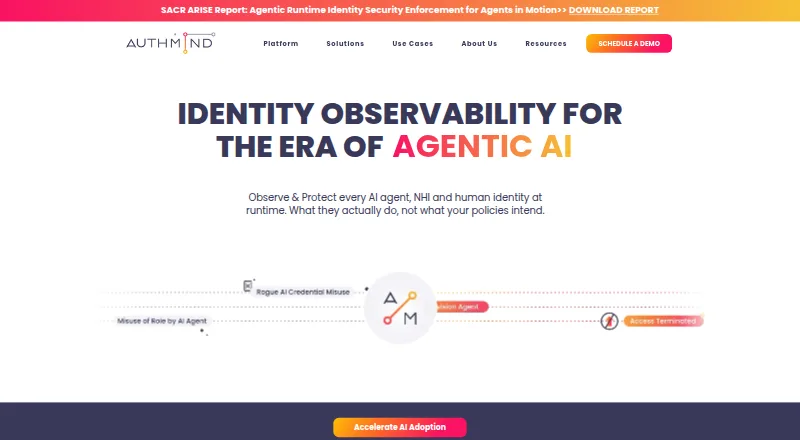
What AuthMind Advanced Identity Threat Detection and Response is
AuthMind Advanced Identity Threat Detection and Response is an identity security platform for detecting threats and supporting remediation across connected infrastructure. It identifies human users, non-human identities, and AI agents, then links known and unknown identities to their owners. By correlating identity and system events with network, cloud, and application telemetry, it maps access routes and builds a real-time graph of how identities reach applications, services, data, and infrastructure. Detection includes compromised accounts, brute-force attempts, secret misuse, unusual agent activity, missing MFA, token theft, session hijacking, privilege abuse, lateral movement, and shadow access. Its response framework works across identity providers, endpoints, networks, SASE, PAM, and security tools. Listed integrations include Okta, Microsoft Entra ID, Splunk, CrowdStrike, AWS, Zscaler, HashiCorp Vault, and ServiceNow. AuthMind describes the product as proprietary SaaS designed for customer infrastructure, with coverage spanning cloud, SaaS, on-premises systems, networks, and other systems. It is available via web and self-hosted platforms. Pricing is on request; fees are set by agreement and based on purchased services rather than actual usage. The default initial subscription term is one year, renewing annually unless otherwise specified.
Good
- Maps unknown identities to their owners.
- Access graph shows routes to data and infrastructure.
- Detects token theft and privilege abuse.
- Response spans identity, endpoint, network, and security tools.
- States SOC 2 Type II compliance and independent audits.
Watch out
- Pricing is available on request.
- Default subscription begins with a one-year term.
- Prepaid fees are not refunded for unused access.
- Self-hosted and web are the listed platforms.
Who it suits
AuthMind may suit organizations seeking visibility into identities and access across cloud, SaaS, on-premises, network, and system environments. It is aimed at teams addressing identity threats and coordinating remediation across security tools.
Verdict
AuthMind focuses on identity discovery, access mapping, threat detection, and coordinated response. Prospective customers need to request pricing and review the applicable subscription agreement.
The facts
Each one read from AuthMind Advanced Identity Threat Detection and Response's own pages, with the date it was checked.
What it does
- Access graph
- AuthMind builds a real-time Identity Activity Access Graph to map how identities access applications, services, data, and infrastructure.checked 30 Sep 2026
- Access visibility
- AuthMind correlates identity and system events with network, cloud, and application or service logs to map access paths.checked 29 Sep 2026
- Commercial terms
- The SaaS terms state that fees are set in the applicable agreement, quoted and payable in U.S. dollars unless otherwise specified, and that the default initial subscription term is one year unless the agreement specifies otherwise.checked 30 Sep 2026
- Deployment scope
- The platform page describes coverage across cloud, SaaS, on-premises, networks, and systems.checked 30 Sep 2026
- Identity coverage
- The platform discovers and maps AI agents, non-human identities, and human identities to their owners.checked 29 Sep 2026
- Integrations
- Listed integrations include Okta, Microsoft Entra ID, Splunk, CrowdStrike, Zscaler, AWS, ServiceNow, HashiCorp Vault, and IBM QRadar.checked 30 Sep 2026
- ITDR
- The Advanced ITDR solution targets external and insider identity threats, including token theft, session hijacking, privilege abuse, lateral movement, and shadow access.checked 30 Sep 2026
- Notable fee condition
- The SaaS terms say fees are based on services purchased rather than actual usage, and prepaid fees are not refunded for unused access.checked 30 Sep 2026
- Product
- AuthMind describes its platform as identity observability and protection for agentic AI, non-human, and human identities.checked 30 Sep 2026
- Response
- AuthMind says its remediation framework supports response across identity providers, endpoints, networks, SASE, PAM, and security tools.checked 30 Sep 2026
- Sales and support
- The site invites visitors to register for a one-to-one platform demo and lists [email protected] as its contact email.checked 30 Sep 2026
- Security assurance
- AuthMind states that it is SOC 2 Type II compliant and independently audited for platform security, availability, and confidentiality.checked 30 Sep 2026
- Security compliance
- AuthMind states that its platform is SOC 2 Type II compliant and independently audited for security, availability, and confidentiality.checked 29 Sep 2026
- Service model
- AuthMind describes the service as proprietary software as a service designed to integrate with a customer's network, systems, and software infrastructure.checked 29 Sep 2026
- Subscription term
- Unless an agreement specifies otherwise, the initial subscription term is one year and renews automatically for successive one-year terms.checked 29 Sep 2026
- Support contact
- AuthMind lists [email protected] as its contact email.checked 29 Sep 2026
- Threat detection
- It detects threats including MFA bypass, compromised identities, brute-force attacks, misuse of secrets and roles, and unusual AI agent activity.checked 30 Sep 2026
The company
- Company founding
- AuthMind says it was founded by industry veterans but does not state a founding year on its About page.checked 30 Sep 2026
- Founded
- 2020checked 23 Sep 2026
- Headquarters
- AuthMind lists its USA address as 6701 Democracy Blvd, Suite 300, Bethesda, MD 20817.checked 30 Sep 2026
Where it runs
- Identity mapping
- The platform maps known and unknown identities to their owners and correlates identity events with network, cloud, and application telemetry.checked 30 Sep 2026
The full review of AuthMind Advanced Identity Threat Detection and Response
AuthMind Advanced Identity Threat Detection and Response is identity-security software for organizations that need to understand and respond to risks across human, machine, and AI-agent identities. It is strongest for teams managing access across cloud, SaaS, on-premises systems, networks, and applications; custom pricing and a one-year default commitment make it a considered enterprise purchase.
Overview
AuthMind discovers identities, including unknown ones, and maps them to their owners. By correlating identity events with network, cloud, and application or service logs, it builds a real-time view of how identities reach applications, services, data, and infrastructure. That access mapping is valuable when identity activity spans more than a single provider or environment, but the product is proprietary SaaS designed to integrate with a customer's infrastructure, so it suits organizations prepared to connect it to their systems.
Its Advanced ITDR offering addresses external and insider threats, including token theft, session hijacking, privilege abuse, lateral movement, and shadow access. Detection also covers compromised identities, brute-force attacks, secret misuse, unusual agent activity, and missing MFA. AuthMind supports remediation across identity providers, endpoints, networks, SASE, PAM, and security tools, giving response teams a broad set of potential control points.
Key features
- Identity discovery and ownership: Maps human identities, non-human identities, and AI agents, including unknown identities, to owners. This helps teams make sense of accounts and agents that may not be apparent from an identity-provider view alone.
- Access-path visibility: Correlates identity and system events with network, cloud, and application or service logs to construct an Identity Activity Access Graph. The graph is intended to show how identities access applications, services, data, and infrastructure.
- Threat detection: Identifies credential theft, directory attacks, privilege abuse, brute-force attempts, secret misuse, unusual agent activity, and missing MFA. The breadth is useful for teams investigating identity risk across people and machine identities rather than just conventional user logins.
- Coordinated remediation: Supports response across identity providers, endpoints, networks, SASE, PAM, and security tools. The range can help teams act beyond the identity layer, although the value depends on fitting the product into their existing systems.
- Integrations and assurance: Listed integrations include Okta, Microsoft Entra ID, Splunk, CrowdStrike, AWS, Zscaler, HashiCorp Vault, and ServiceNow. AuthMind states that the platform is SOC 2 Type II compliant and independently audited for security, availability, and confidentiality.
Pricing
AuthMind is paid software with custom pricing. Fees are set in the applicable agreement, quoted and payable in U.S. dollars unless otherwise specified, and based on services purchased rather than actual usage. That model may suit organizations buying a defined service package, but it offers no usage-based reduction if access goes unused; prepaid fees are not refunded for unused access.
Unless the agreement says otherwise, the initial subscription term is one year and renews automatically for successive one-year terms. Buyers should confirm the purchased services, fees, renewal terms, and any different term directly in their agreement before committing. AuthMind invites prospective customers to register for a one-to-one platform demo and lists [email protected] as its contact email.
Platforms
AuthMind is available as self-hosted and web software. Its described coverage spans cloud, SaaS, on-premises environments, networks, and systems, though the service itself is proprietary SaaS designed to integrate with a customer's infrastructure.
Who it's for
AuthMind is a strong candidate for security teams that need to map human, non-human, and AI-agent identities to owners, trace access across a mixed environment, and coordinate response across several security layers. It is less suited to buyers seeking a simple standalone tool, transparent fixed pricing, or fees that fall with lower usage.
Pros and cons
Pros
- Broad identity coverage: Maps human identities, non-human identities, and AI agents, including unknown identities, to their owners.
- Access context across environments: Correlates identity activity with network, cloud, and application telemetry to show access paths.
- Wide threat and response scope: Detection spans several identity risks, while remediation can reach identity providers, endpoints, networks, and security tools.
- Independent security audit: AuthMind states that its SOC 2 Type II platform is independently audited for security, availability, and confidentiality.
Cons
- Custom pricing: Buyers must request a quote, making cost harder to compare before engaging with sales.
- Usage does not determine fees: Fees are based on purchased services, and prepaid unused access is not refunded.
- Automatic annual renewal by default: The default one-year term renews for successive one-year terms unless the agreement specifies otherwise.
- Integration-oriented SaaS: The service is designed to connect with customer infrastructure, which is a poor fit for teams wanting a self-contained deployment without integration work.
Alternatives
Compare AuthMind with other Identity Threat Detection and Response Software options if you are weighing deployment, trials, and identity-security scope.
- Silverfort is another paid option, with API, self-hosted, and web platforms; consider it when its Plus plan's non-human identity and AI-agent security or Enterprise plan's access intelligence and privileged access features better match your priorities.
- Choose Vectra AI Identity Threat Detection and Response if a free trial and API access are important; its paid Vectra AI ITDR plan is priced by contacting Vectra AI.
- Delinea Identity Threat Protection is a paid alternative with a free trial and Android, iOS, web, and Windows platforms, making it worth considering when those client platforms matter.
- Semperis Identity Resilience Platform is another paid option.
- Sophos ITDR is a paid web option.
- Gurucul Identity Threat Detection and Response is a paid web option.
- Permiso Identity Security Platform is a paid web option.
- Reveal Security Platform is a paid web option.
Verdict
Choose AuthMind if your security team needs to discover identities across people, machines, and AI agents, map their access paths, and coordinate identity-threat response across a broad environment. Its main advantage is the combination of identity mapping, telemetry correlation, and cross-layer remediation. Look elsewhere if you need predictable public pricing or a purchase that is not tied to a default annual commitment and fees for services regardless of actual usage.
Alternatives to AuthMind Advanced Identity Threat Detection and Response
- 1

Blumira
Free planAndroidiOSWebAPI8.2Free plan - 2
Microsoft Defender for Business
AndroidiOSAPImacOS7.5 - 3

IBM Verify
AndroidiOSWebAPI7.3From $15,899.29 a year - 4

Delinea Identity Threat Protection
AndroidiOSWebWindows6.3 - 5
 5.8
- 65.7