
Alumni OS
Alumni OS is a platform for university alumni offices, schools, and chapter organizations to coordinate members, events, dues, giving, and operational data.
What Alumni OS is
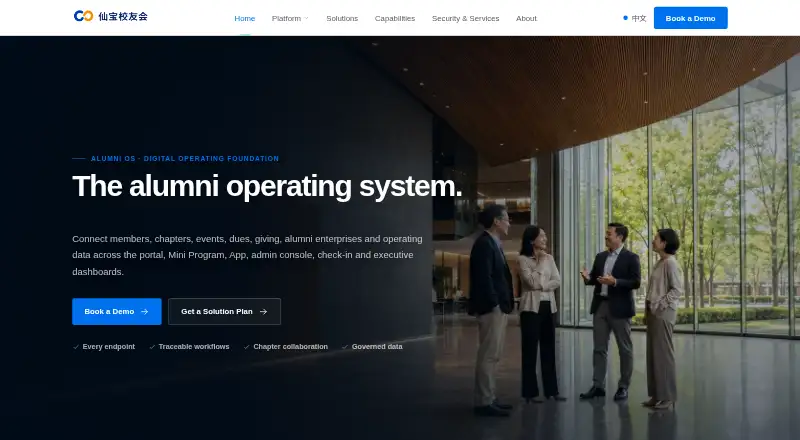
Alumni OS is a platform for university alumni offices, schools, and chapter organizations to coordinate members, events, dues, giving, and operational data. Its tools span a member portal, Mini Program, app, admin console, event check-in, and dashboards. Members can verify identity, use digital alumni cards and directories, register for events, manage tickets, review dues and giving history, and access lifelong services. A shared CRM profile can bring together identities, chapters, contacts, tags, historical records, engagement timelines, and follow-up work. Organizations can manage multi-level chapters, event workflows, membership rules, giving campaigns, orders, refunds, ledgers, and reconciliation. Audience building can use cohort, region, sector, chapter, or behavior, while analytics cover growth, chapter health, event conversion, and fund trends. The interface is described as native Chinese and English. Privacy controls include consent, field classification, masking, export controls, audit logs, and account-closure workflows. Deployment options are assessed per project, and pricing is on request. Payment, invoicing, and finance rely on qualified third-party integrations.
Good
- Combines member services and administrative tools.
- Supports multi-level chapter management.
- Offers event registration, tickets, access, and reminders.
- Provides privacy and access controls.
Watch out
- Pricing is available on request.
- Payments and finance depend on third-party integrations.
- Deployment options are assessed per project.
Who it suits
Alumni offices, schools or faculties, regional or sector chapters, and education groups are the stated audiences. It can also serve alumni members who need event, dues, giving, and directory services.
Verdict
Alumni OS covers member engagement and the administrative work behind chapters, events, dues, and giving. Prospective organizations should clarify project scope, deployment, and the third-party services needed for payment and finance.
Plans and prices
From Alumni OS's own pricing page, checked 9 Oct 2026.
| Plan | Price | What it gives you |
|---|---|---|
| Custom project plan | Priced on request | Tailored scope and delivery; SaaS, dedicated, and private deployment options assessed per project |
The facts
Each one read from Alumni OS's own pages, with the date it was checked.
What it does
- Access controls
- Roles, capabilities and data scopes can follow headquarters, schools, regions, sectors, cohorts and other chapter levels.checked 8 Oct 2026
- Alumni profiles
- It combines verified identity, roles, tags, interactions, and service history in a shared member profile.checked 9 Oct 2026
- Audience
- The platform is presented for university alumni offices, schools or faculties, regional or sector chapters, and alumni members.checked 9 Oct 2026
- Chapter management
- It supports multi-level chapters spanning headquarters, schools, regions, sectors, cohorts, and classes.checked 9 Oct 2026
- CRM
- The CRM links alumni profiles, identities, chapters, contacts, historical records, tags, engagement timelines and follow-up work.checked 8 Oct 2026
- Deployment
- SaaS, dedicated, and private deployment options can be assessed for a project, with campus identity and data integrations available.checked 9 Oct 2026
- Dues and giving
- Dues and giving features include membership rules, campaigns, orders, refunds, ledgers, and reconciliation; payment, invoicing, and finance depend on third-party integrations.checked 9 Oct 2026
- Engagement and analytics
- The product supports audience building by cohort, region, sector, chapter, and behavior, plus insights into growth, chapter health, event conversion, and fund trends.checked 9 Oct 2026
- Events
- Event workflows include creation, approval, invitations, registration, charges, check-in, surveys, and review.checked 9 Oct 2026
- Integrations
- Projects can connect approved identity, master-data, payment, messaging, and other institutional services.checked 9 Oct 2026
- Intended users
- The site describes the product for university alumni offices, school or faculty associations, regional or sector chapters, and schools or education groups.checked 8 Oct 2026
- Languages
- The site describes a native Chinese and English user interface.checked 9 Oct 2026
- Member experience
- Members can use identity verification, digital alumni cards, directories, event registration and tickets, dues and giving history, and lifelong services.checked 8 Oct 2026
- Migration and recovery
- Delivery can include data inventory, cleaning, mapping, trial migration, verification, and defined backup cycles, recovery objectives, and response plans.checked 9 Oct 2026
- Payment boundary
- Payment, invoicing and finance depend on qualified third-party integrations.checked 8 Oct 2026
- Privacy controls
- Privacy measures include consent, field classification, masking, export controls, audit logs and account-closure workflows.checked 8 Oct 2026
- Product
- Alumni OS connects members, chapters, events, dues, giving, alumni enterprises, and operating data across a portal, Mini Program, app, admin console, check-in, and executive dashboards.checked 9 Oct 2026
- Product scope
- Alumni OS connects members, chapters, events, dues, giving, alumni enterprises and operating data across a portal, Mini Program, app, admin console, check-in and dashboards.checked 8 Oct 2026
- Security and privacy
- The maker describes role and organization scopes, consent, field classification, masking, export controls, audit logs, and account-closure workflows; it says compliance assessments are planned around each project.checked 9 Oct 2026
- Support
- The maker describes role-based training, launch support, and continuous review as part of its delivery process.checked 9 Oct 2026
- Support and delivery
- The company describes discovery, phased delivery, migration, training, launch support and continuous improvement.checked 8 Oct 2026
The company
- Headquarters
- 11F, Building B, Nano University Science Park, No. 388 Ruoshui Road, Suzhou Industrial Park, Jiangsu, Chinachecked 28 Sep 2026
The full review of Alumni OS
Alumni OS is a broad alumni-relations and administration platform for universities, faculties, schools, and chapter networks. It suits organizations that need one operating view across members, chapters, events, fundraising, and institutional data. Its strongest case is complex, multi-level programs prepared to fund a tailored deployment; organizations wanting a self-serve price and standard setup should look elsewhere.
Overview
The platform joins member services and back-office work across a portal, Mini Program, mobile app, administrative console, event check-in, and executive dashboards. Alumni offices can manage profiles, chapter activity, events, dues, giving, alumni enterprises, and operational data in the same environment rather than stitching together separate tools. That breadth is valuable when one institution serves many cohorts or regions, but it also means the implementation has to be designed around the organization’s governance and existing systems.
Alumni OS is presented as a project-led product. Discovery, data migration, training, launch support, and continuing improvement are part of the described delivery approach, with SaaS, dedicated, and private deployment assessed for each project. This is a better fit for institutions with a defined implementation owner than for a small group seeking an immediately configured application.
Key features
Member records and CRM
Profiles combine verified identity, roles, tags, interactions, and service history. CRM functions add chapter affiliations, contacts, historical records, engagement timelines, and follow-up work. That shared record gives an alumni office a practical basis for coordinated outreach and service tracking, especially when people belong to several chapters or programs.
Chapters and access
Organizations can run multi-level chapters with onboarding, terms, leaders, members, and annual work. Roles, capabilities, and data scopes can follow headquarters, schools, regions, sectors, cohorts, or other chapter levels. The model matches layered educational governance, although configuring those boundaries is an important part of the project rather than a one-click setup.
Events, dues, and giving
Members can verify identity, use digital alumni cards and directories, register for events, access tickets, and review dues and giving history. Event workflows span discovery, registration, payment, ticketing, access, and reminders. Dues and giving cover membership rules, campaigns, orders, refunds, ledgers, and reconciliation, giving fund-raising teams a fuller operational trail than a basic event calendar. Payment, invoicing, and finance remain dependent on qualified third-party integrations, so those workflows should be validated before commitment.
Analytics, privacy, and migration
Audience building can use cohort, region, sector, chapter, and behavior, while dashboards provide views of growth, chapter health, event conversion, and fund trends. Consent controls, field classification, masking, export controls, audit logs, and account-closure workflows support a more disciplined privacy model. Delivery can include data inventory, cleaning, mapping, trial migration, verification, backup cycles, recovery objectives, and response plans. Compliance assessments are planned around each project, making contractual and technical review especially important.
Pricing
Custom project plan: custom pricing. Scope and delivery are tailored, with SaaS, dedicated, and private deployment options assessed per project. There is no published seat quota, free tier, trial period, or standard renewal term to use for a quick budget comparison. Buyers should request a proposal that separates implementation, migration, integrations, deployment, training, and ongoing support.
Platforms
Alumni OS supports Android, iOS, web, API, and self-hosted deployment. The user interface is described as natively available in Chinese and English. The combination suits institutions that need mobile member access, browser administration, and connections to approved identity, master-data, payment, messaging, and other institutional services.
Who it's for
University alumni offices, school or faculty associations, regional or sector chapters, and broader education groups are the intended users. It is particularly appropriate where multiple organizational levels, formal identity verification, chapter reporting, and integrated dues or giving matter. A smaller association with one chapter and uncomplicated payments may find the project-oriented model heavier than necessary.
Pros and cons
- Pro: One environment covers member services, chapters, events, dues, giving, and executive reporting, reducing operational gaps between front-office and administrative teams.
- Pro: Multi-level roles and data scopes can mirror complex university and chapter structures.
- Pro: Migration planning, role-based training, launch support, and continuous review address the practical work of institutional rollout.
- Con: Custom scope and deployment assessment make cost and delivery effort harder to compare with packaged products.
- Con: Payment, invoicing, and finance depend on qualified third-party integrations rather than being self-contained.
- Con: The breadth of governance, privacy, and migration options requires substantial project definition before launch.
Alternatives
For a wider category comparison, see Alumni Management Software.
- Scholva Alumni Network is the better starting point for a small community wanting a free plan for up to 200 students on Android or web.
- AlumniMS suits organizations that want a free web plan for up to 100 members with all 15 platform modules, while accepting limits such as no custom domain or priority support.
- Feending is worth considering when an API and web service with an unlimited-user free tier, one administrator, dashboard, database, posts, and chat are the priority.
- AlumUnion fits institutions seeking a free web platform with no setup, subscription, or per-member charge, with fees applied to online payments.
- AlmaShines is an alternative for teams preferring defined annual plans for Android, iOS, and web.
- Anthology Encompass is another paid Android, iOS, and web option.
- AlumnForce is suited to buyers who want paid Android, iOS, web, and API access with published monthly plans.
- Alumnly is a paid Android, iOS, and web alternative with a free trial and an annually billed Starter plan.
Verdict
Choose Alumni OS when a university or education network needs a coordinated, multi-level alumni operation spanning member identity, chapters, events, dues, giving, analytics, and institutional integrations. Its main reason to look elsewhere is the same breadth: organizations that need transparent pricing, a short self-serve setup, or finance handled without third-party integration will be better served by a simpler alternative.