
Academy Launcher
Academy Launcher brings course creation, delivery, commerce and academy operations together under a creator’s brand.
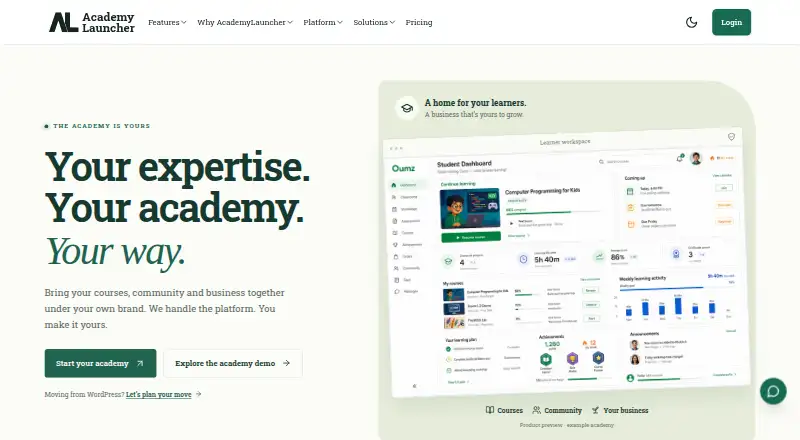
What Academy Launcher is
Academy Launcher brings course creation, delivery, commerce and academy operations together under a creator’s brand. Its tools cover curricula, lessons, quizzes, assignments and learner support, as well as live workshops, coaching, communities and recurring memberships. Creators can build branded pages and keep academy touchpoints under their own domain. Sales tools include eCommerce, memberships, subscriptions, affiliates, email campaigns, sales funnels and automations; community features include cohorts, bookings, feeds, chat and messages. An AI builder can draft course outlines, lessons and questions for creators to review and edit. Customers can use a managed database or connect their own Supabase project for authentication, database and file storage. Listed integrations include Stripe, Google Meet, OpenAI, Supabase and Resend; customers supply provider accounts or credentials and manage billing directly. AcademyLauncher says it is in beta and offers a 30-day trial. Trial checkout shows payment requirements, the first charge date and cancellation terms. The product is built by VibeThemes, the team behind WPLMS.
Good
- Supports courses, live workshops, coaching and memberships.
- Includes assessments, assignments and progress tracking.
- AI builder drafts content for human review and editing.
- Offers a managed database or customer Supabase connection.
- Supports branded pages and custom-domain touchpoints.
Watch out
- The company says the product is in beta.
- Customers bring provider credentials and manage provider billing.
- Trial checkout includes payment requirements and cancellation terms.
- Plan allowances should be reviewed before signup.
Who it suits
Academy Launcher is intended for independent educators, professional academies and learning teams that want course delivery, community and commerce tools under their own brand.
Verdict
Academy Launcher combines learning, community, branding and sales features with a choice of database setup. Since it is in beta, review plan allowances, provider choices and trial terms before signing up.
The facts
Each one read from Academy Launcher's own pages, with the date it was checked.
What it does
- AI assistance
- Its AI builder can draft course outlines, lessons and questions for the creator to review and edit.checked 3 Oct 2026
- AI oversight
- The company says humans remain responsible for consequential decisions and that consequential AI-assisted actions involve human approval.checked 3 Oct 2026
- Audience
- The company identifies independent educators, professional academies and learning teams as audiences it is building for.checked 3 Oct 2026
- Beta status
- AcademyLauncher says it is in beta and advises reviewing plan allowances and provider choices before signup.checked 3 Oct 2026
- Branding
- Users can build pages, apply visual branding and keep academy touchpoints under their own domain.checked 3 Oct 2026
- Commerce
- Listed sales and growth tools include eCommerce, memberships, subscriptions, affiliates, email campaigns, sales funnels and automations.checked 3 Oct 2026
- Community
- The platform lists communities, cohorts, bookings and social learning through feeds, chat and messages.checked 3 Oct 2026
- Course tools
- The platform supports course curricula, lessons, quizzes, assignments and learner support.checked 3 Oct 2026
- Database options
- Customers can use a managed database or connect their own Supabase project for authentication, database and file storage.checked 3 Oct 2026
- Infrastructure choice
- Users can choose a managed database or connect their own Supabase project for authentication, database and file storage.checked 3 Oct 2026
- Integration controls
- The integrations page says customers bring provider accounts or credentials and manage provider billing directly.checked 3 Oct 2026
- Integrations
- The official integrations page lists Stripe, Google Meet, OpenAI, Supabase and Resend among its connections.checked 3 Oct 2026
- Intended users
- The company identifies independent educators, professional academies and learning teams as audiences for the product.checked 3 Oct 2026
- Learning features
- Its feature page lists live classes, an AI instructor, an AI builder, an AI evaluator, assessments and achievements.checked 3 Oct 2026
- Learning formats
- The homepage says AcademyLauncher supports courses, live workshops, coaching, communities and recurring memberships.checked 3 Oct 2026
- Migration
- AcademyLauncher offers a migration review that assesses courses, learners, enrollments, progress, orders and integrations before confirming scope and cost.checked 3 Oct 2026
- Operations
- The platform lists reports and dashboards, gamification, certificates, policies and documents.checked 3 Oct 2026
- Purpose
- AcademyLauncher brings course creation, delivery, commerce and academy operations together under the creator’s brand.checked 3 Oct 2026
- Support
- The homepage links to contact support, migration services and a knowledge base.checked 3 Oct 2026
- Trust status
- The company says AcademyLauncher is in beta.checked 3 Oct 2026
The company
- Maker
- AcademyLauncher is built by VibeThemes, the team behind WPLMS.checked 3 Oct 2026
- Ownership and AI oversight
- The company describes direct ownership of a connected Supabase project and human approval for consequential AI-assisted actions.checked 3 Oct 2026
Money
- Trial terms
- The homepage says trial checkout shows payment requirements, the first charge date and cancellation terms.checked 3 Oct 2026
The full review of Academy Launcher
Overview
Academy Launcher brings course delivery, community, commerce and academy operations together under an educator’s brand. It best suits independent educators and learning teams building a broader academy rather than a single standalone course. Its mix of teaching tools and database choices is compelling, but its beta status and 1,000-student limit call for a close look at fit before committing.
Key features
Course curricula, lessons, quizzes, assignments and progress tracking cover the core learning workflow, while live classes, workshops, coaching and cohort scheduling support formats that depend on interaction. Communities add feeds, chat and messages; bookings and memberships can extend learning beyond a fixed course. This breadth is useful for programs that blend instruction and ongoing participation, but may be more than a course-only operation needs.
An AI builder can draft outlines, lessons and questions for creators to review and edit. The platform also lists an AI instructor and evaluator, assessments and achievements. Human approval is required for consequential AI-assisted actions, a meaningful guardrail when generated material or actions could affect learners. The creator still needs to review and own the result.
Branding tools let users build pages, apply visual styling and use their own domain. Sales tools include eCommerce, memberships, subscriptions, affiliates, email campaigns, funnels and automations; reports, dashboards, certificates, policies and documents address academy operations. The range makes Academy Launcher a candidate for organizations seeking one branded environment across learning and sales, though provider accounts and billing remain the customer’s responsibility.
Customers can use a managed database or connect their own Supabase project for authentication, database and file storage. Integrations include Stripe, Google Meet, OpenAI, Supabase and Resend. Bringing provider credentials and managing those providers separately offers control, but adds setup and billing responsibilities. Migration review assesses courses, learners, enrollments, progress, orders and integrations before scope and cost are confirmed.
Pricing
Academy Launcher is paid, with no free plan and a 30-day trial. The homepage says trial checkout shows payment requirements, the first charge date and cancellation terms, so review those before starting. Plan allowances and provider choices also warrant attention: the company says the product is in beta, and the stated student limit is 1,000. No plan prices or tier breakdowns are provided, so compare the applicable allowances and custom pricing with the size and needs of your academy before signup.
Platforms
Academy Launcher supports Android, iOS, web and API access. The combination suits teams serving learners across mobile and browser environments or connecting the academy to other software.
Who it's for
Independent educators can use the branded course, community and commerce tools to build a business around teaching. Professional academies and learning teams may value the operational features, cohort support and infrastructure choice. It is less suitable for a small, course-only project that needs a free starting tier, or for an organization expecting more than 1,000 students.
Pros and cons
- Pros: Course creation, live learning, community and sales tools sit in one branded platform, supporting programs that combine several formats and revenue streams.
- Pros: Managed database and customer-owned Supabase options provide a choice between a managed setup and direct project ownership.
- Pros: Migration review considers learning records, orders and integrations before scope and cost are settled.
- Cons: There is no free plan, and the product is in beta; teams should check trial terms and plan allowances carefully.
- Cons: Provider accounts and billing stay with the customer, adding coordination for integrations.
- Cons: The 1,000-student limit may rule it out for larger academies.
Alternatives
Cohort-Based Course Platforms is a useful comparison point for readers choosing around cohort delivery.
Choose Sublime LMS if a free sandbox with 50 active learners, two published courses and one admin or instructor is a better starting fit; it supports web and API. UjuziPlus offers a free Creator plan with a course builder, quizzes, marketplace selling and basic learner reporting, plus Android and iOS support. For a custom enterprise learning solution, consider NovoEd, whose platform is paid and priced through a custom solution.
Cohorta has a free plan for one product, 50 learners and 500 monthly email messages, with a 10% sales commission—an option for a small operation prioritizing a free start. Teachfloor may fit teams seeking a paid Startup plan with 50 user seats, unlimited courses and 10 GB of file storage. Pathwright offers a paid Starter plan for 1,000 members, one administrator and one cohort per course, which may suit a program with a defined cohort structure.
Learnyst is another paid option, with a Professional plan priced at ₹26,997 a year plus taxes and three sub-admin seats. Nialtus has a free plan capped at 10 active learners, five courses and one admin, making it a smaller-scale free alternative.
Verdict
Academy Launcher is best for educators and learning teams who want branded courses, live and cohort learning, community and commerce in one system, with a choice of database setup. That breadth is its main reason to choose it. Look elsewhere if you need a free plan, a settled non-beta product, or capacity beyond 1,000 students; otherwise, review trial terms, provider responsibilities and plan allowances before signing up.